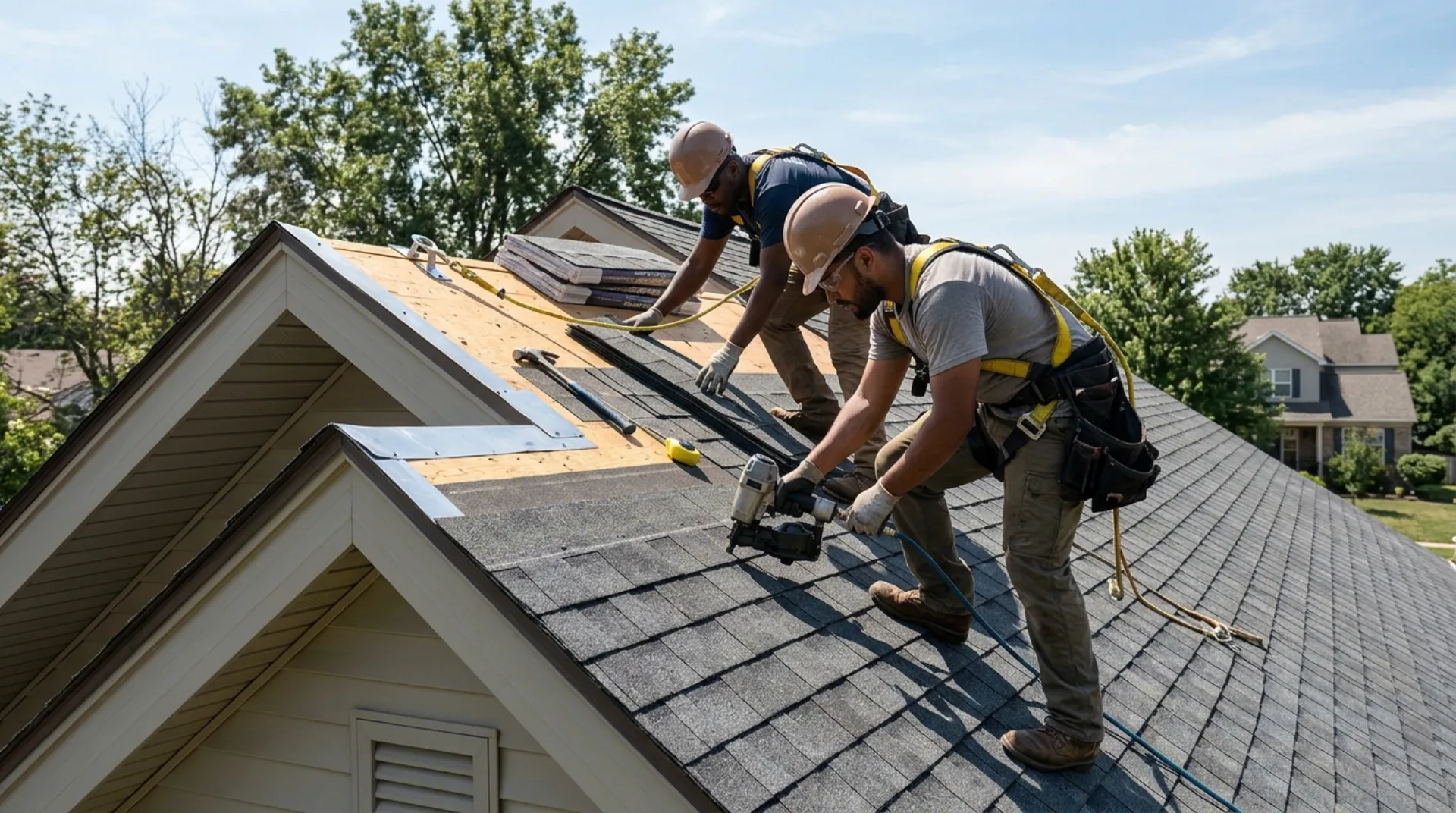
Roofing Software,
$29/mo Flat.
· Pricing verified June 14, 2026
Send a $25K replacement estimate with roof photos from the truck, see the moment the homeowner opens it, collect a deposit before the materials hit the supplier, and have Menutize text the homeowner a one-tap Google review link the day the crew rolls off. $29/mo flat. One seat, +$15/seat. Start free.
CRM, invoicing & payments — one flat $29/mo for one seat, teammates just $15/seat (half of Jobber's $29/user), no tier upgrades like Roofr, AccuLynx & JobNimbus.
Roofing software, explained plainly
Menutize is $29/mo flat roofing software for storm-restoration crews, re-roofers, repair specialists, and small-to-solo roofing contractors. It runs the office and money side of a roofing business — customer CRM, photo estimates with side-by-side material tiers, big-ticket invoicing, deposit and split-payment collection, online card and ACH payments, date-stamped insurance-claim photo logs, automated Google review requests, tip collection, and two-way Google Calendar sync — for one flat $29 per month for a single seat, with additional teammates at $15/seat. There is no per-job fee, and you can sign up free with no card to explore, then pay $29/mo when you send your first invoice.
Roofing is the highest-ticket trade in residential home services, which is exactly why a low, flat-rate tool with a cheap payment rail fits it so well. A standard architectural-asphalt-shingle replacement typically runs $9,000–$18,000, with the broader U.S. range spanning roughly $7,500 to $30,000 and storm jobs reaching far higher — about $300–$600 per roofing square, or $4–$11 per square foot installed. On a single $15,000 invoice, even a small payment-processing difference is real money, so “flat-rate invoicing plus a cheap ACH rail” saves more per job in roofing than in almost any other trade. The tools that win those jobs are fast photo estimates that close on the homeowner's phone, deposits collected before materials are ordered, itemized invoices an adjuster won't kick back, and a steady flow of fresh Google reviews that keep you in the local Map Pack.
The platforms most roofers evaluate fall into two camps. The roofing-native leaders — AccuLynx and JobNimbus — are deep and powerful but publish no price, force a sales demo, and use per-user pricing that can hit roughly $1,200/mo (~$14,400/yr) for a 10-person crew plus $500–$5,000 in setup. The transparent horizontal tools — Jobber, and roofing's own Roofr — are easier to buy, but Jobber and Housecall Pro have no free-forever plan (trial only), and Roofr's free Starter tier is really a measurement-ordering on-ramp that still charges $13–$19 per report and gates invoicing and payments behind $109–$349/mo paid tiers. A fragmented stack of separate estimating, scheduling, invoicing, measurement, and photo tools commonly costs a roofer $500–$1,200/mo across three to five platforms that don't talk to each other. Menutize is one flat $29/mo instead — one seat, every feature included, extra teammates at $15/seat — so your office software stays a small, predictable line item even through the slow winter months.
A growing share of homeowners now find roofers through an AI answer before they ever click a website — asking ChatGPT, Perplexity, or Google's AI Overviews “how much does a new roof cost” or “best roofer near me for storm damage.” Those answers are assembled from structured, factual, citation-ready content and from your local presence: your Google Business Profile, your review count and recency, and your visibility in the Map Pack. So the two highest-return investments for a roofing shop are now (1) a steady, automated flow of recent Google reviews and (2) fast, photo-rich estimates that convert the leads you do get. Menutize is built to drive both.
One honest caveat up front: roofers genuinely need aerial roof measurement and insurance-restoration workflow (Xactimate-style scope, material ordering, production boards). Menutize does not measure roofs and does not replace an estimating suite. It is the flat-$29 money-and-CRM backbone for small and solo roofers — photo estimates, deposits, itemized claim invoicing, reviews — not a replacement for AccuLynx-grade production management. Where measurement matters, pair Menutize with a measurement tool (Roofr's reports, an EagleView/Hover order) and keep your software bill at one flat $29/mo.
The rest of this page covers what's included, the four roofing-specific workflows Menutize is built around, a full side-by-side comparison against Roofr, AccuLynx, JobNimbus, iRoofing, and Jobber with verified 2026 pricing, a plain-language read on each competitor, real roofing cost ranges and deposit norms, a five-question buying guide, a day-in-the-workflow walkthrough, an honest section on when a heavier platform is the right call, and the questions roofers actually ask before signing up.
What's Included
Everything you need to run a roofing business — not a feature gated behind an upgrade. No credit card to start. No "trial expired" email in 14 days.
Customer CRM
Every homeowner, job, photo, and note in one place. Searchable. One seat included; add teammates at $15/seat.
Photo Estimates
Branded estimates with unlimited roof photos from your phone, plus side-by-side material tiers. Customer approves with one tap.
Big-Ticket Invoicing
Auto-generate itemized invoices with claim numbers and sales tax the moment a job closes. No QuickBooks license required.
Deposits, Card & ACH Payments
Collect a 10-30% deposit, then the balance. ACH at 0.8% (capped at $5) is the cheap rail for $10K–$25K balances.
Google Review Requests
Auto-text every happy homeowner a one-tap review link the moment the crew rolls off the curb.
Tip Collection
Built-in tip prompts at checkout. A happy homeowner on a clean tear-off often thanks the crew on the screen.
Built for the way roofing actually works.
Roofing isn't general handyman work. You're sending $9K–$30K estimates with photo evidence, fronting six figures in shingles after a hailstorm, documenting every claim for an adjuster who kicks back one-liner invoices, juggling A-crew tear-offs and a B-crew on repairs, and you need to know which homeowner has actually opened the quote before you make the follow-up call. The $29/mo plan accounts for all of it.
A hail-damaged roof on an insurance claim is not the same job as a Saturday gutter clean, and your software shouldn't pretend it is. Most "free" small-business tools are an invoice template with a Stripe button bolted on — fine for a freelance designer, useless when an adjuster wants pre-tear-off photos and a claim-number-tagged, line-itemed invoice. Menutize was built around the four workflows below: the ones that actually decide whether a roofing shop closes the $20K replacement that pays for the month or watches it walk to the next contractor in the search results.
Big-Ticket Photo Estimates with Tier Pricing
A $25,000 estimate without photos is a leap of faith. Menutize estimates carry unlimited photos and side-by-side price tiers, so a homeowner approves a full replacement from their phone without a second site visit. Snap the ridge, the valleys, the hail divots, the soft decking, and the old flashing right from your phone, drop them into the estimate, and the homeowner sees the evidence the same way you did on the roof. Then offer three tiers on the same screen — 3-tab asphalt, architectural shingle, and standing-seam metal — each with materials, warranty terms, and total price. The homeowner taps the option they want and signs. Visual tier comparison does the up-sell for you: most roofers report homeowners self-select up to the “Better” option when they see all three side by side at dinner instead of hearing them listed on a call.
Date-Stamped Insurance-Claim Photo Log
A large share of roofing work is insurance and storm restoration, and that work lives or dies on documentation. Menutize stamps every photo and note with a date and the user who added it, so when the adjuster wants pre-tear-off shots, mid-job decking proof, and post-install pictures, they're all in one place on the customer's record instead of buried in your camera roll. Pull it up on your phone in the kitchen meeting, email any individual shot straight to the carrier, and stop losing supplements just because you couldn't find the photo from the second visit. Pair it with itemized invoicing — adjusters route payment by claim number and demand line items, not one-liners like “Roof replacement — $18,500” — and the whole claim moves faster.
Estimate & Invoice Open-Tracking
A $25K estimate sitting unread is a different problem than one the homeowner has opened twice but hasn't signed. Menutize notifies you the moment the customer opens the estimate email, views the live estimate page, or opens an invoice — through to the moment they pay. That matters because a big replacement quote sits on a phone for two or three days while the spouse looks at it, the neighbor weighs in, and somebody Googles the shingle brand. Knowing when the quote was just opened lets you make the close call at the right moment, not on Monday when you've already moved on. You stop guessing whether anyone's seen it, and you stop chasing leads who already signed someone else. Most field-service tools gate this behind a paid tier; Menutize ships it in every plan.
Crew & Subcontractor Coordination
When you've got an A-crew on full tear-offs, a B-crew running repairs, and a sub crew you only call after a hailstorm spike, a single calendar fast turns into noise. Menutize lets you tag each job to the crew or sub running it, and shows each crew's week cleanly while the owner keeps the master view — addresses, materials, customer phone numbers, gate codes. This handles the post-storm reality where a tear-off, a decking repair, and a final detail crew can all touch the same address on different days. Subs get a clean handoff, you stop fielding “wait, which house?” texts at 6:30am, and nobody shows up at the wrong driveway. Menutize adds each foreman, helper, and the bookkeeper as a $15 seat on the flat $29 base — roughly half the $29/user (Jobber) or $30–$120/user (AccuLynx, per third-party reports) the paid platforms charge past their included seats.
Three Things Every Roofing Pro Wishes They Had
Most "free" software either nags you to upgrade or leaves out the features that actually move the needle. Menutize makes the three biggest ones core to the plan.
Auto Google Reviews
The moment you mark a roof complete, the homeowner gets a one-tap review link by text. No copy-paste, no "I'll do it later." In storm-damage roofing, the local Map Pack ranking is where the next ten leads come from when the next hailstorm hits — the homeowner with a damaged roof is searching "roofer near me" and clicking the top three results. Review count and recency are among the strongest local-ranking signals, so automating the ask after every clean job compounds month over month.
Included.
Tip Requests at Checkout
Customers see a tip prompt right at payment — the same flow they're used to from Square or DoorDash. Roofing tips skew larger than restaurant tips: a homeowner who just watched a crew tear off and re-roof their house clean, on schedule, often wants to thank the team, and the prompt makes it effortless for them and tactful for you. No awkward ask, no cash changing hands in the driveway.
Included.
Google Calendar Two-Way Sync
Every estimate and scheduled job lands in your real Google Calendar. Block time on your phone — supplier run, adjuster meeting, your kid's game — and Menutize won't let customers book over you. Jobber and Roofr reserve their richer scheduling and calendar features for paid tiers; Menutize includes two-way Google Calendar sync at $29/mo flat.
Included.
Menutize vs Roofr vs AccuLynx vs JobNimbus vs iRoofing vs Jobber
A feature-by-feature comparison for roofing contractors, with pricing checked against each vendor's pricing page on June 15, 2026. Roofr, iRoofing, and Jobber prices are verified live; AccuLynx and JobNimbus are sales-gated (no public price), so their figures are third-party and clearly flagged as unverified. Menutize is the only option with one flat $29/mo base price and $15 teammate seats, but it does not measure roofs — see the honest read below the table.
| Feature | Menutize | Roofr | AccuLynx | JobNimbus | iRoofing | Jobber |
|---|---|---|---|---|---|---|
| Starting price | $29/mo flat | Free Starter ($19/report); Measure+ $109/mo | Quote only (~$250/mo, 3rd-party est.) | Quote only (~$225/mo base, 3rd-party est.) | $124/mo annual ($149 m/m) (verified Jun 2026) | $29/mo annual ($49 m/m), Core |
| Mid / popular tier | n/a — one flat $29 plan | Essentials $249/mo | Pro/Elite ~$60–$120/user/mo (est.) | Pro (up to 10 users) — quote | $124/mo, 12-mo (most popular) | Grow $149–$299/mo annual ($199–$399 m/m) |
| Top tier | n/a | Scale $349/mo (unlimited seats) | Elite — quote only | Premium (up to 19) / Enterprise — quote | $107/mo, 24-mo (best value) | Plus $529/mo annual ($699 m/m) |
| $29/mo, 1 seat (+$15/seat) | Yes | No (free Starter = measurement on-ramp) | No (no trial) | No (14-day trial) | No (subscription only) | No (14-day trial) |
| Users included / add-on | $29/mo, 1 seat (+$15/seat) | Flat tiers; Scale = unlimited seats | Per-user (~$60–$120/user, est.) | Per-user by tier (~$30–$75/user, est.) | 3 users, flat rate, no per-user fee | 1–15 by tier; +$29/user/mo |
| Annual contract required | No | No (up to 15% off annual) | Sales-gated contract | Sales-gated contract | No (monthly or 12/24-mo for less) | No (annual prepay = lower price) |
| Photo estimates with tier pricing | Yes, unlimited — included | Yes (proposals, paid tier) | Yes (SumoQuote, paid) | Yes (paid plan) | Yes (estimating + visualizer) | Yes (paid plan) |
| Aerial / satellite roof measurement | No | Yes ($13–$19/report) | Yes (integrations) | Yes (EagleView/Hover) | Yes (core strength) | No |
| Insurance-restoration / claim workflow | Claim-number invoicing + photo log | Limited | Yes (deep, core strength) | Yes (purpose-built) | Limited | No |
| Date-stamped photo documentation | Yes — included | Yes (paid tier) | Yes (SmartDocs add-on) | Yes (photo storage limits reported) | Yes | Yes (paid plan) |
| Estimate & invoice open-tracking | Yes — included | Yes (paid tier) | Limited | Limited (weak reporting reported) | Limited | Higher tier |
| Deposit / split-payment collection (card & ACH) | Yes — included | Yes (CC + ACH, paid tier) | Yes (QuickBooks sync) | Yes (JobNimbus Payments) | Lighter / limited | Yes (paid plan) |
| ACH at 0.8% (capped $5) | Yes — included | ACH available; rate varies | Varies | Varies | Varies | Card-focused; varies |
| Automated Google review requests | Yes — included | Add-on / varies | Add-on / varies | Engage add-on ($49–$249/mo) | Limited | Add-on / higher tier |
| Tip collection at checkout | Yes — included | Rarely supported | Rarely supported | Rarely supported | Rarely supported | Rarely supported |
| Two-way Google Calendar sync | Yes — included | Higher tier | Yes (paid plan) | Yes (paid plan) | Limited | Higher tier |
| Material ordering / production boards | No | Lighter | Yes (deep) | Yes (Kanban boards) | Lighter | Scheduling only |
| Est. 1st-year software cost (1 owner + 1 helper) | $348/yr flat (1 seat; +$15/seat) | $0 (Starter) to ~$1,308–$4,188 (paid) + per-report | ~$3,000–$14,400+ (per-user) + $500–$5K setup (est.) | ~$2,700–$6,600+ base + per-user + Engage (est.) | $1,284–$1,788 (flat, 3 users incl.) | ~$348+ (Core annual; +$29/mo for 2nd user) |
Pricing checked June 15, 2026. Verified live: Roofr (roofr.com/pricing) — Starter free, $19/measurement report; Measure+ $109/mo ($13/report); Essentials $249/mo; Scale $349/mo (unlimited seats); up to 15% off annual; measurement reports are always pay-as-you-go. iRoofing (iroofing.org/pricing) — flat-rate, 3 users included, no per-user fee: $149/mo month-to-month, $124/mo on the 12-month plan ($1,488/yr, most popular), $107/mo on the 24-month plan ($2,576, best value); perimeter reports from $10; no free plan. (Note: iroofing.com is an unrelated roofing contractor, not the software vendor — its /pricing 404s; the software vendor is iroofing.org.) Jobber (getjobber.com/pricing) — Core $29/mo annual ($49 m/m), Connect $99–$149/mo annual, Grow $149–$299/mo annual, Plus $529/mo annual; +$29/user/mo; 14-day trial only. Sales-gated / no public price (third-party estimates, UNVERIFIED, shown for context only): AccuLynx — acculynx.com/pricing is a demo form; trackers cite an Essential plan from ~$250/mo and Pro/Elite at ~$60–$120/user/mo, with a 10-person crew reported at ~$1,200/mo plus $500–$5K setup; no free plan or trial. JobNimbus — jobnimbus.com/pricing is a quote form; account-based tiers (Essentials/Pro/Premium/Enterprise), 14-day trial, no free-forever plan; trackers cite ~$225–$550/mo base plus per-user (~$75 admin / $55 sales / $30 field) and an Engage texting add-on at $49–$249/mo. Card-processing fees apply on all platforms; Menutize uses standard Stripe rates on payments processed. First-year estimates assume annual-prepay pricing where available and exclude measurement-report, processing, and implementation fees. Menutize does not provide aerial roof measurement, material ordering, or Xactimate-style production management.
Menutize vs each platform, in plain language
The table above is the quick scan. Here is the honest, vendor-by-vendor read for a roofing owner deciding where to put the office work — what each tool costs, who it's actually for, and where Menutize wins or loses. The short version: the roofing-native tools do measurement and production management that Menutize doesn't; Menutize does the money-and-CRM backbone they charge a fortune for, at one flat $29/mo.
Menutize vs Roofr
Roofr is the closest thing roofing has to Menutize, and the only major roofing-specific tool with a genuine free plan. Its Starter tier is $0/mo — but it's really a measurement-ordering on-ramp, not a full CRM, and every measurement report is pay-as-you-go at $19. Paid tiers are Measure+ at $109/mo ($13/report), Essentials at $249/mo, and Scale at $349/mo (Roofr's Most Popular plan, with unlimited team seats). Invoicing, proposals, and card/ACH payments live on those paid tiers, and measurement reports are never free.
Where Roofr wins is the thing Menutize doesn't do at all: fast aerial/satellite roof measurement feeding an instant estimator and a slick proposal builder with e-sign. It's genuinely the best on-ramp from a satellite image to a signed proposal. Where Menutize wins is everything around the money — CRM, invoicing, deposits, card + ACH payments, and review automation, all included at $29/mo flat — with no per-report charge and no paid tier to unlock getting paid. Pick Roofr if you live on measurement reports and want them self-serve. Pick Menutize if you want included invoicing, deposits, and reviews — or pair the two: order measurements in Roofr, run the money in Menutize, keep your software bill at one flat $29/mo.
Menutize vs AccuLynx
AccuLynx is the most feature-complete all-in-one roofing platform — CRM, estimating, production scheduling, job costing, material ordering, and insurance-restoration in one login — with strong reviews (4.5/5 on Capterra across 729 reviews) and a two-way QuickBooks sync. It publishes no price: acculynx.com/pricing is a demo-request form. Third-party trackers (unverified) cite an Essential plan from around $250/mo and premium per-user tiers at roughly $60–$120 per user per month, with real-world reports of a 10-person crew at about $1,200/mo (~$14,400/yr) in seats alone, plus $500–$5,000 setup. Users also report that features like SmartDocs, texting, the customer portal, and DataMart are each a separate monthly add-on, so the real bill runs well above the sticker.
This is the clearest “different tools for different shops” case on the page. AccuLynx is built for an established production roofer who needs material ordering and deep restoration workflow and can absorb four- to five-figure annual cost. Menutize deliberately doesn't replicate that depth; it's the flat-$29 backbone for the small or solo roofer AccuLynx prices out. Pick AccuLynx if you run multiple crews with material ordering and production scheduling and want one heavy login. Pick Menutize if you're a one-to-three crew shop that wants photo estimates, deposits, itemized claim invoices, and reviews without a per-user bill — and don't mind ordering measurements separately.
Menutize vs JobNimbus
JobNimbus is the best-loved sales-pipeline CRM for residential roofers — drag-and-drop production boards, a purpose-built insurance-claim workflow, an open API, and supplier integrations like EagleView, ABC Supply, and Beacon Pro, with strong ratings (Capterra 4.64/5, G2 4.8/5). It publishes no public price (jobnimbus.com/pricing is a quote form) and uses account-based tiers — Essentials (up to 3 users), Pro (up to 10), Premium (up to 19), Enterprise (20+) — with a 14-day trial and no free-forever plan. Unverified trackers cite roughly $225–$550/mo base plus per-user fees (about $75 admin, $55 sales, $30 field tech) and an Engage texting add-on at $49–$249/mo. Real-user gripes cluster on three-layer pricing opacity, email-system reliability, app crashes, and photo-storage limits.
JobNimbus gives you deeper sales pipeline boards and roofing-specific supplier integrations than Menutize does. Menutize gives a small crew the same job-winning loop — photo estimates, open-tracking, deposits, itemized claim-number invoicing, reviews — at $29/mo flat ($15 per extra seat), with no Engage-style texting upcharge to send a review request. Pick JobNimbus if you want Kanban production boards and EagleView/supplier integrations and will pay base-plus-seats-plus-Engage for them. Pick Menutize if you want the estimate-deposit-invoice-review workflow at $29/mo flat and are fine ordering measurements elsewhere.
Menutize vs iRoofing
iRoofing is a roofing-specific measurement, sales, and estimating tool with flat-rate, predictable pricing and no per-user fee — which undercuts AccuLynx and JobNimbus on monthly cost for small-to-mid crews. Its published pricing (iroofing.org/pricing, verified June 2026) is $149/mo month-to-month, $124/mo on the 12-month plan ($1,488/yr, its most popular) or $107/mo on the 24-month plan ($2,576, best value), with three users included and no per-user fee; perimeter measurement reports start at $10 and there's no free-forever plan. iRoofing's strengths are aerial/satellite measurement, the catalog and roof visualizer, and a polished in-home sales presentation.
It's narrower than the full all-in-one suites — lighter on full production management, job costing, and native payments/invoicing depth. Menutize doesn't measure roofs at all, so on the measurement-and-visualizer front iRoofing wins outright. But for the office and money side — CRM, invoicing, deposits, card + ACH payments, review automation — Menutize is $29/mo flat for one seat ($15 per extra) where iRoofing is a higher flat monthly fee with lighter payments. Pick iRoofing if measurement and a slick visual sales pitch are your priority. Pick Menutize if you want CRM, invoicing, and getting-paid at $29/mo flat, and will handle measurement and the in-home demo your own way.
Menutize vs Jobber
Jobber is the cheapest transparent entry point of the established platforms and a clean, well-built home-services tool with native QuickBooks Online sync and fast professional invoicing. Core is $29/mo on an annual plan ($49 month-to-month) but includes only one user. The popular Grow tier — the one Jobber's own trial drops you into — runs $149–$299/mo annually ($199–$399 month-to-month) and includes ten users, and the top Plus tier is $529/mo annually ($699 month-to-month). Every additional user beyond a plan's cap is $29/mo. There's no free-forever plan; you get a 14-day trial and then the card is charged.
The catch for roofing specifically is that Jobber is horizontal, not roofing-specific: no aerial roof measurement, no insurance-restoration or Xactimate-style workflow, no material ordering or roofing production boards. So you're paying a subscription for a generic field-service tool and still buying measurement and restoration tooling elsewhere. Menutize is also not a measurement tool, but it matches Jobber on the core roofing money workflow — photo estimates, tiered options, deposits, online payments, scheduling — and adds estimate open-tracking, tip collection, and Google review automation included, at $29/mo flat with $15 teammate seats. Pick Jobber if you want its broad integrations ecosystem and don't mind the subscription. Pick Menutize if you want the same job-winning workflow at $29/mo flat, with $15 teammate seats.
What a new roof actually costs — and how to quote and bill it fast
Roofing is the highest-ticket trade in residential home services, and price swings widely with material, pitch, square footage, layers to tear off, decking condition, and access. The ranges below reflect typical U.S. cost guidance — use them as a starting framework, then build your own material line items into a Menutize service menu so you can quote on-site in two taps and bill itemized invoices an adjuster won't kick back.
| Job type | Typical U.S. range | What moves the number |
|---|---|---|
| Architectural-shingle replacement | $9,000–$18,000 | The bread-and-butter re-roof; cost climbs with square footage, pitch, and number of old layers to tear off. |
| Full U.S. replacement range | $7,500–$30,000+ | Spans a small simple roof to a large, steep, or premium-material roof; metal and tile push the top end well past $30K. |
| Per-square / per-square-foot | ~$300–$600 / square ($4–$11 / sq ft) | A roofing square is 100 sq ft; material grade, pitch, and waste factor move the unit number. |
| Deposit at signing | ~10%–30% of total | Covers mobilization and protects against cancellation; 50% exists but is high-end and discouraged. Write it on the estimate. |
Roofing has too many variables to quote reliably over the phone, which is exactly why on-site photo estimates with pre-built material line items close more work than a verbal number a homeowner half-remembers. (The ranges above are illustrative industry figures — from sources like HomeGuide, Modernize, Angi, and NerdWallet — not Menutize quotes; your real numbers depend on your market, your crew, and the specific roof.) In Menutize, set up “Roof inspection,” “Repair visit,” “Architectural-shingle replacement,” “Standing-seam metal replacement,” and “Storm/emergency response” as menu items with your own base prices, then adjust per job, attach roof photos, and present three tiers before you send.
Deposits and split payments are the cash-flow lever. The industry-standard deposit is 10–30% at signing to cover mobilization, with the balance on completion; on a retail re-roof you can set the deposit and collect it the moment the homeowner taps approve, securing both the materials order and the crew date. Best practice is to write the deposit terms right on the estimate (for example “15% deposit due at signing, applied to final invoice”) — verbal deposit deals get disputed, and a signed, tapped estimate is your paper trail. Because a single roofing balance can be $10K–$25K, the ACH rail (0.8%, capped at $5) versus a card (~2.9%) is the difference between $5 and several hundred dollars in fees per job, which is why educating homeowners on ACH once pays for itself.
Insurance and storm work bill differently, and the invoice format matters. A large share of roofing revenue is storm restoration, where the carrier pays by claim number and the adjuster demands itemized line items, not one-liners like “Roof replacement — $18,500.” Insurance jobs often pay in two parts — an actual-cash-value (ACV) check up front and recoverable depreciation released after the work passes inspection — and your estimate frequently diverges from the carrier's Xactimate scope, which is what supplements exist to reconcile. Menutize won't write your Xactimate scope, but it lets you record the claim number on the invoice, itemize the line items the adjuster expects, and keep the date-stamped before/during/after photo log that supports the supplement — so the documentation your office already chases is organized in one record instead of scattered across a camera roll.
Seasonality is the reason a low, predictable software bill matters in this trade. A typical roofing company books roughly 65–70% of annual revenue between April and September while carrying fixed costs through the off-season, and a single storm can produce the biggest sales week of the year followed by a 90-day cash trough as insurance checks crawl in. A flat $109–$550/mo SaaS bill from the roofing platforms arrives every month regardless and climbs as you add users; Menutize is one flat $29/mo — the smallest fixed software bill in the category and the same no matter how many crew members you add — so even through the off-season your software cost stays at the bottom of the range.
How to choose roofing software
Most buying guides bury the decision under a feature checklist. For a roofing business, five questions settle it. Answer these and the right tool — or the right pairing — is usually obvious.
1. How much of your work is insurance / storm restoration?
If most of your jobs run through a carrier, you need date-stamped photo documentation and itemized, claim-number invoicing more than anything else, plus deep supplement workflow if you're high-volume. AccuLynx and JobNimbus own the deep restoration workflow; Menutize covers the documentation-and-billing layer (photo log, claim number, itemized invoice) free, and pairs with whatever Xactimate/estimating tool your office already runs.
2. Do you need aerial roof measurement built in?
Roofers genuinely need measurement, and this is Menutize's honest gap. If you want self-serve satellite/aerial measurement reports inside the same tool, Roofr or iRoofing are built for that. Menutize does not measure roofs — the smart play for a small shop is to order measurements à la carte (Roofr reports, EagleView, Hover) and run the money in Menutize, keeping the software bill near zero.
3. How weather-dependent and seasonal is your revenue?
Very. Roofing books ~65–70% of revenue April–September and a single storm can swing a quarter. When revenue is that lumpy, you want the lowest, most predictable fixed bill you can get — and one flat $29/mo is the smallest fixed software bill in the category, the same whether you booked ten roofs or none this month and the same no matter how many crew members you add. This is the core reason Menutize's flat $29/mo fits a small roofer better than Jobber's, Roofr's, or AccuLynx's higher, tiered monthly fees.
4. How many people need a login, and how big is your crew?
Count the owner, every foreman, the helpers, and the bookkeeper. On per-seat platforms that's $29 (Jobber) to $60–$120 (AccuLynx, per third-party reports) per extra user per month — a 10-person crew can hit ~$1,200/mo in seats alone. Menutize charges just $15 per extra seat on its flat $29 base — roughly half the per-user rate of the paid platforms — so as your crew grows, that lower per-seat rate changes the total cost materially, which is where Menutize pulls ahead.
5. Do you need full production management — or just to win and bill jobs?
This is the honest dividing line. If you run material ordering, production scheduling boards, job costing, and deep multi-crew restoration, AccuLynx or JobNimbus are built for that. If you're a solo-to-small re-roof or repair shop that mainly needs to win the estimate, collect the deposit, bill the claim, and earn the review, you don't need an enterprise production suite — a free tool that nails that loop (and a measurement order when you need one) is the smarter call.
The right pick by business stage
You + a helper or two
You're the salesperson, the dispatcher, and on the roof when someone calls in sick. You need fast photo estimates, deposits, itemized invoices, and reviews — not a production board. Menutize covers all of it at $29/mo flat; order measurements à la carte when a job needs one.
Multiple crews, heavy claims
High insurance volume and several crews/subs. If you live in deep supplement workflow and material ordering, JobNimbus or AccuLynx earn their cost. If you mainly need claim docs + billing + reviews, Menutize still fits, with $15 teammate seats and a Roofr/EagleView measurement order on the side.
Crews, material ordering, job costing
You need CRM + estimating + production scheduling + material ordering + restoration in one login, and you can absorb four- to five-figure annual cost. This is where a free tool stops being enough. AccuLynx (deepest all-in-one) or JobNimbus (sales-pipeline depth) is the right investment.
A day in the workflow
It's the morning after a hailstorm and your phone hasn't stopped. A homeowner two neighborhoods over has bruised shingles, a leak over the kitchen, and an insurance adjuster coming Thursday. You're pulling on boots, so instead of scribbling the address on a coffee-cup sleeve you add the customer in Menutize on the way to the truck. Two more calls come in before 8am; you tag both, and they land on your Google Calendar without colliding with the tear-off already scheduled for Wednesday.
At the first stop you walk the roof and shoot the evidence — ridge, valleys, hail strikes on the slopes, soft decking by the chimney, and the old step flashing. Each photo lands on the customer's record with a date stamp and your name on it, which is exactly what the adjuster will want Thursday. From your phone you build the estimate with three tiers — 3-tab, architectural, standing-seam metal — attach the photos, set the deposit at 15%, and send it before you're back in the truck. By the time you reach the second address, Menutize has notified you the homeowner opened the estimate twice.
The second job is a straightforward retail repair, no claim. You quote it on the spot and move on. Mid-morning the first homeowner taps the architectural option, signs, and pays the deposit by ACH; the $5 cap means you keep nearly the whole deposit instead of losing card points on a four-figure number, and the materials order goes in that afternoon. The job locks onto Wednesday's schedule, tagged to the tear-off crew.
Thursday, you pull the customer record up on your phone in front of the adjuster — pre-tear-off photos, decking proof, the itemized estimate with the claim number already on it. No digging through a camera roll. Wednesday the crew finishes clean; you mark the roof complete from the field, the auto Google review request texts the homeowner a one-tap link while the dumpster is still on the trailer, and the tip prompt is right there on the balance payment screen.
By Friday you've got a fresh five-star review, a paid balance billed itemized for the carrier, a documented claim file, and a tip the crew wasn't expecting — all run from a phone on one flat $29/mo — one seat, extra teammates just $15 — with no tier upgrade to buy no matter how busy the next storm makes you.
When not to use Menutize for roofing
Menutize is the wrong tool if your business runs on capabilities it deliberately doesn't have. It does not provide aerial or satellite roof measurement — if you want measurement reports inside the same app, use Roofr or iRoofing (or order EagleView/Hover and run the money in Menutize). It is not an Xactimate-style estimating engine or a deep insurance-restoration suite; if your shop lives in supplement scope-writing, material ordering, and multi-crew production boards, AccuLynx (the deepest all-in-one) or JobNimbus (purpose-built claim pipeline with EagleView/ABC Supply integrations) is built for that, and the per-user cost pays for itself at production scale.
Likewise, if you're an established production roofer running multiple crews with job costing, material POs, and board-level reporting as the daily core of the business, a lean, flat-rate CRM-and-payments backbone won't carry that load — that's exactly what the roofing-native platforms charge for.
For everyone else — the solo or small roofer, the storm-chaser's sub, the repair-and-re-roof shop that mainly needs to win the estimate, collect the deposit, document the claim, bill it itemized, and earn the review — Menutize covers the money workflow at $29/mo flat. Start free, pair it with a measurement order when a job needs one, and move up only if you truly outgrow it.
Why the flat-$29 math works in this trade
Three things the public data makes clear about roofing economics — and why a $29/mo flat tool with reviews and deposits built in is a structural advantage, not a gimmick.
The fragmented stack you avoid
A typical roofer pays for separate estimating, scheduling, invoicing, measurement, and photo tools — $500–$1,200/mo across three to five platforms that don't talk to each other (per published roofing-software comparisons). Menutize collapses CRM, invoicing, and payments into one flat $29/mo login, so you only pay à la carte for measurement when a job needs it.
Of revenue in 6 months
Roofing companies book roughly 65–70% of annual revenue April–September while carrying fixed costs all year (per a cited seasonal cash-flow study). A flat monthly SaaS bill from the roofing platforms hits in the off-season anyway and climbs as you add users; Menutize is one flat $29/mo for one seat ($15 per extra), so your software bill sits at the bottom of the range year-round.
ACH vs card on a $25K balance
Because roofing invoices are so large ($10K–$18K typical), the payment rail is material money. ACH at 0.8% capped at $5 costs $5 on a $25,000 balance; a ~2.9% card costs roughly $725. Included invoicing plus a cheap ACH option saves more per job in roofing than in almost any other trade.
Figures above are composites drawn from public vendor pricing pages (Roofr and Jobber verified June 14, 2026; iRoofing verified June 15, 2026 at iroofing.org; AccuLynx and JobNimbus are sales-gated, third-party-sourced, and unverified), published roofing-software comparisons, and industry cost guides — not testimonials from named businesses. Your results depend on your market, your pricing, and how consistently you use the review and estimate tools.
Roofing Software Questions, Answered
The ones roofers actually ask before they sign up.
Is Menutize really $29/mo flat for roofing contractors? What's the catch?
How does Menutize compare to Roofr for roofing?
How does Menutize compare to JobNimbus for roofing?
How does Menutize compare to Jobber for roofing?
Can I send big-ticket roof estimates with photos of the roof from multiple angles?
Does Menutize help with roofing insurance-claim documentation?
How do I collect a deposit before I order roofing materials?
Can I see when a homeowner opens my roof estimate?
How do customers pay me for big roofing jobs, and how does ACH save money?
How does the automated Google review request work for roofers?
How much does Menutize cost, and how much do I save?
What happens to my customer data if I leave Menutize, and how long does setup take?
Great roofing software, one flat $29/mo.
Photo estimates, big-ticket invoicing, deposits, insurance-claim photo logs, Google reviews, tips, calendar — all included in one flat $29/mo for one seat (teammates $15/seat). Setup takes 10 minutes. Start free, no card.
Start free — no credit cardSet up in 10 minutes. Explore free, then $29/mo when you send your first invoice. No contract, cancel anytime.