Plumbing Software,
$29/mo Flat.
· Pricing verified June 14, 2026
Take a service call from the truck, charge the diagnostic fee before you roll, send unlimited invoices the moment the leak's fixed, collect the water-heater deposit by ACH, and let Menutize text the customer a one-tap Google review link automatically. $29/mo flat. One seat, +$15/seat. Start free.
CRM, invoicing & payments — one flat $29/mo for one seat, teammates just $15/seat (half of Jobber's $29/user), no $189–$245/mo floor like Housecall Pro & Service Fusion.
Plumbing software, explained plainly
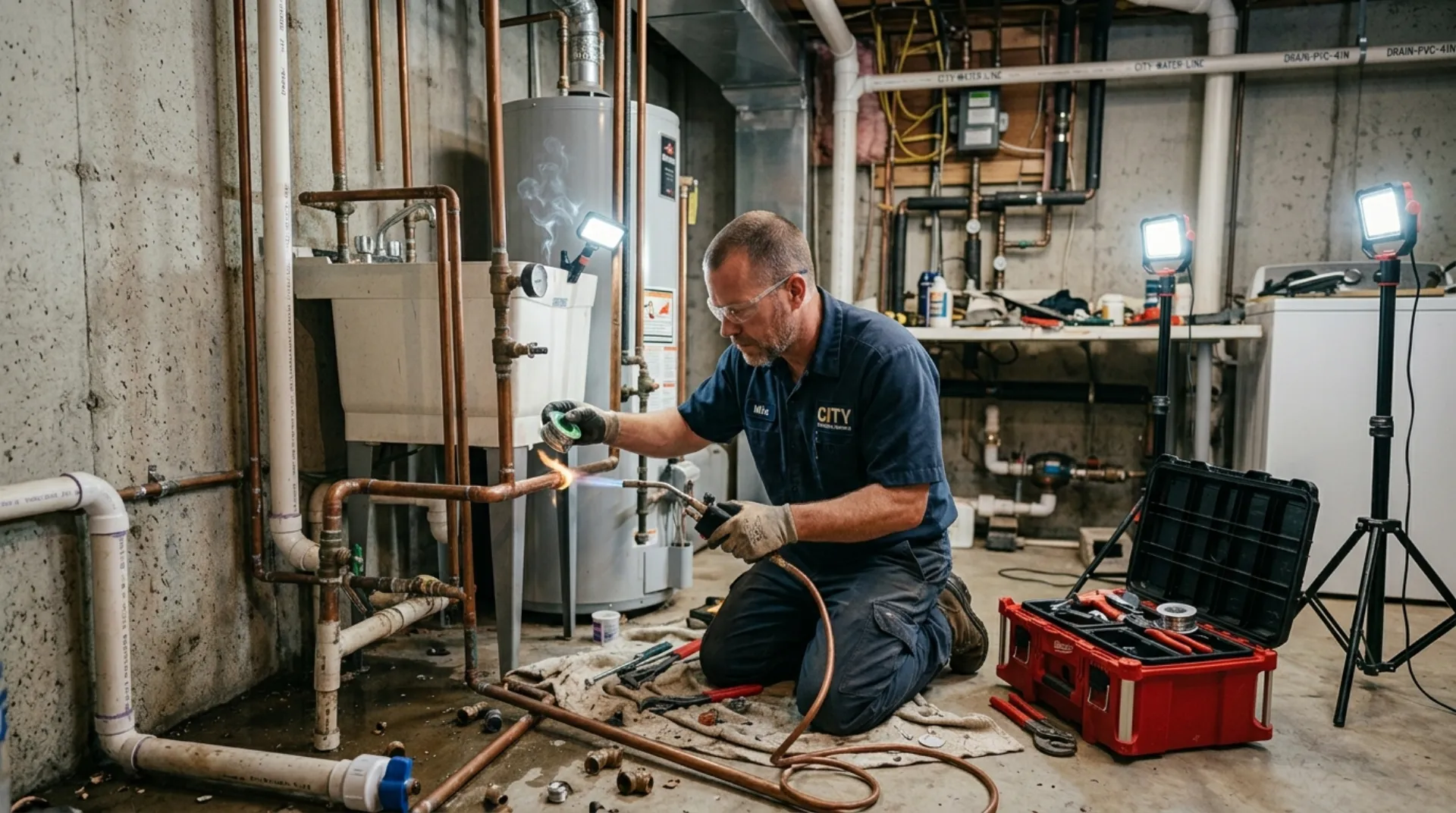
Menutize is $29/mo flat plumbing software for solo plumbers, drain and sewer specialists, water-heater installers, and small plumbing shops. It runs the office side of a plumbing business — customer CRM, estimates, on-site invoicing, paid diagnostic deposits, emergency after-hours surge pricing, deposit collection on big install jobs, online card and ACH payments, automated Google review requests, tip collection, recurring maintenance-plan billing, and two-way Google Calendar sync — for one flat $29 per month for a single seat, with additional teammates at $15/seat. There is no per-job fee, and you can sign up free with no card to explore, then pay $29/mo when you send your first invoice.
Plumbing is a high-velocity, weather-driven trade, which is exactly why a free, payment-based tool fits it. The average plumbing service ticket runs around $327 nationally, with most jobs falling between roughly $175 and $480 and water-heater and repipe work climbing well past that. Demand spikes hard in winter when pipes freeze and burst, and emergency calls command premiums of 50% to 100% over standard rates. The tools that win those jobs are fast estimates that close on the customer's phone, diagnostic deposits that filter out tire-kickers, surge pricing that the homeowner self-selects at 1am, and a steady flow of fresh Google reviews that keep you in the local Map Pack. Menutize was built around exactly those moments.
The platforms most plumbers evaluate — Jobber, Housecall Pro, Service Fusion, plus the trade-specific Workiz and the job-priced ServiceM8 — almost all charge a monthly subscription, several charge per additional user, and the "free" tiers that do exist are deliberately throttled. Jobber, Housecall Pro, and Service Fusion have no free plan at all (trial-only, or no trial). ServiceM8's free tier caps you at 30 jobs a month; Workiz's free Lite tier caps you near 20 jobs and strips out payments, SMS, and automations. For a solo plumber or a 1-3 truck shop, the functional entry point on the paid tools is roughly $189–$245/mo — about $2,300–$2,900/yr before a single drain is cleared. Menutize is one flat $29/mo instead — one seat, every feature included, extra teammates at $15/seat, no job cap — so your office software stays a single predictable line item even in the slow weeks.
A growing share of homeowners now find plumbers through an AI answer before they ever click a website — asking ChatGPT, Perplexity, or Google's AI Overviews "how much does a water heater install cost" or "best emergency plumber near me." Those answers are assembled from your local presence: your Google Business Profile, your review count and recency, and your visibility in the Map Pack. So the two highest-return investments for a plumbing shop are now a steady, automated flow of recent Google reviews and fast, deposit-backed estimates that convert the leads you get — both of which Menutize is built to drive, which is why it fits where local search is heading better than a platform that bills you monthly for dispatch features you'll never open.
The rest of this page covers what's included, the four plumbing-specific workflows Menutize is built around, a full side-by-side comparison against Jobber, Housecall Pro, ServiceM8, Workiz, and Service Fusion with verified 2026 pricing, a plain-language read on each competitor, real plumbing cost ranges, a five-question buying guide, a day-in-the-workflow walkthrough, an honest section on when a bigger platform is the right call, and the questions plumbers actually ask before signing up.
What's Included
Everything you need to run a plumbing business — not a feature gated behind an upgrade. No credit card to start. No "trial expired" email in 14 days. No 20-job ceiling that forces an upgrade in week one.
Customer CRM
Every customer, job, photo, and note in one place. Searchable. One seat included; add teammates at $15/seat.
Estimates & Quotes
Send branded estimates from your phone with photos and side-by-side tier options. Customer approves with one tap.
Unlimited Invoicing
Auto-generate clean invoices the moment a job closes — no job cap, no per-invoice fee. No separate QuickBooks license required.
Card & ACH Payments
Customers pay online. Money lands in 1-2 business days. ACH at 0.8% (capped at $5) is the cheap rail for water-heater and repipe balances.
Google Review Requests
Auto-text every happy customer a one-tap review link the moment you mark the job done.
Tip Collection
Built-in tip prompts at checkout. The customer whose basement you just saved at midnight gets an easy way to say thanks.
Built for the way plumbing actually works.
Plumbing isn't general handyman work. You're juggling 11pm flooded basements alongside Tuesday-morning water-heater installs, you charge to diagnose because half the calls turn into "I'll think about it," you collect a deposit before buying parts for a repipe, and the work pays in tips more often than your tools track. The $29/mo plan accounts for all of it.
Most "free" small-business software is a generic invoice template with a Stripe button bolted on. It works fine for a freelance designer and falls apart the second a homeowner with three feet of water in their basement is on the phone at 11:47pm asking when you can get there. The throttled "free" tiers in this market are no better — a 20- or 30-job monthly cap is one busy week for a real plumber. Menutize was built around the four workflows below: the ones that actually decide whether a plumbing shop makes money this month or just runs the truck a lot.
Emergency Dispatch & After-Hours Surge Pricing
A burst pipe at midnight isn't the same job as a slow sink on a Wednesday afternoon, and your booking page should know that. Publish two tiers side by side: Standard (next-day, normal rate) and Emergency (same-day, nights, or weekends with a surge price you set). The premium is justified by the trade itself — industry guidance puts evening, weekend, and holiday plumbing at roughly 50% to 100% above standard rates, with emergency labor commonly $150-$300/hr and show-up minimums of $300-$600+. The customer sees both tiers in the moment of crisis and self-selects, and the deposit hits your account before you head out — so you're already paid by the time you're putting on boots at 1am, with no more callouts from people who can't pay when the truck shows up. Winter burst-pipe season is when this tier earns its keep.
Paid Diagnostic Visits with Credit-Back
Stop driving for free quotes. Sell a $79 or $99 diagnostic visit on your booking page — Menutize takes the deposit when the customer schedules, then auto-credits it toward the repair invoice if they say yes. Tire-kickers self-select out (the ones calling six plumbers for free quotes never book a paid one), your truck only rolls when there's money committed, and the customer feels great because the fee comes back when they approve the work. It's the cleanest filter in the trade: a homeowner who has already paid a diagnostic fee is a buyer, not a price-shopper. The deposit collection that makes this work is included in the flat $29/mo, not a paid add-on — on the incumbents, deposit and online-payment features live behind a subscription tier.
Estimate & Invoice Open-Tracking
Menutize notifies you the moment a customer opens your estimate or invoice — every email open, page view, and invoice open is logged. That matters because a $1,800 water-heater quote or a four-figure repipe estimate sits on a phone for two or three days while the homeowner gets a second opinion. Knowing when the quote was just opened lets you make the follow-up call at the right moment instead of cold-chasing on a Sunday, or calling a lead who already booked someone else. The same logic powers unpaid-invoice nudges: you can tell whether a slow payer hasn't looked yet or is sitting on it. Most field-service tools either don't ship open-tracking or gate it behind a higher tier; Menutize includes it in the flat $29/mo plan.
Recurring Maintenance Plans
Sell an annual maintenance agreement — say, $129/yr for a water-heater flush plus a drain inspection, or $199/yr for a whole-home plumbing once-over — and Menutize charges the card automatically every renewal, schedules the visits on your Google Calendar, and reminds the homeowner the week of. Recurring revenue is the antidote to a weather-driven trade: it smooths out the slow stretches between winter burst-pipe season and summer slab-leak season, and it locks in priority customers who call you first when something fails. You stop hand-tracking which customer paid for what plan in a spreadsheet, and the renewal bills itself. Extra seats on the flat $29/mo plan are just $15/seat, so the apprentice, the office spouse, and the part-time dispatcher each add $15/mo — versus the $29/user (Jobber) or $35/user (Housecall Pro MAX) the paid platforms charge past their included seats.
Three Things Every Plumbing Pro Wishes They Had
Most "free" software either nags you to upgrade or leaves out the features that actually move the needle. Menutize makes the three biggest ones core to the plan.
Auto Google Reviews
The moment you mark a plumbing job complete, the customer gets a one-tap review link by text. No copy-paste, no "I'll do it later." Plumbing runs almost entirely on Google reviews and the local Map Pack — the next homeowner with a leak is searching "emergency plumber near me" and clicking the top three results. Review count and recency are among the strongest local-ranking signals, so automating the ask after every clean job compounds month over month.
Included.
Tip Requests at Checkout
Customers see a 15/20/25% tip prompt right at payment — the same flow they're used to from Square or DoorDash. Plumbers get tipped more than they realize, especially after an emergency call: the homeowner whose flooded basement you just saved at midnight wants to say thank you, and the prompt makes it effortless. The tip routes to whichever account the operator chooses, so the tech in the field actually sees and keeps what they earned.
Included.
Google Calendar Two-Way Sync
Every booking and scheduled job lands in your real Google Calendar. Block time on your phone — a wholesale parts run, lunch, your kid's soccer game — and Menutize won't let customers book over you. Jobber and Housecall Pro reserve their richer scheduling for paid tiers, and Workiz strips automations out of its free Lite plan entirely; Menutize includes two-way Google Calendar sync at $29/mo flat.
Included.
Menutize vs Jobber vs Housecall Pro vs ServiceM8 vs Workiz vs Service Fusion
A feature-by-feature comparison for plumbing businesses, with pricing verified directly from each vendor's pricing page on June 14, 2026. Menutize is the only option with one flat $29/mo base price, $15 teammate seats, and no job cap.
| Feature | Menutize | Jobber | Housecall Pro | ServiceM8 | Workiz | Service Fusion |
|---|---|---|---|---|---|---|
| Starting price | $29/mo flat | $29/mo annual ($49 m/m), Core | $59/mo annual ($79 m/m), Basic | $0/mo Free; Starter $29/mo | Free Lite; paid quote-gated (~$229/mo Standard) | $208/mo annual ($245 m/m), Starter |
| Most-popular / mid tier | n/a — one flat $29 plan | Grow $149–$299/mo annual ($199–$399 m/m) | Essentials $149/mo annual ($189 m/m) | Growing $79/mo; Premium $149/mo | Pro ~$270/mo (quote-gated) | Plus $325/mo annual ($382 m/m) |
| Top tier | n/a | Plus $529/mo annual ($699 m/m) | MAX $299/mo annual ($329 m/m) | Premium Plus $349/mo | Ultimate — quote only | Pro $533/mo annual ($627 m/m) |
| $29/mo, 1 seat (+$15/seat) | Yes — no job cap | No (14-day trial) | No (14-day trial) | No (free tier: 30 jobs/mo, 1 user) | No (free Lite: ~20 jobs/mo, no payments) | No (no free tier or trial) |
| Monthly job cap on free/entry | None on invoicing & payments | n/a (no free tier) | n/a (no free tier) | 30/mo free; 50/mo Starter | ~20/mo on Lite | n/a (no free tier) |
| Users included / add-on | $29/mo, 1 seat (+$15/seat) | 1–15 by tier; +$29/user/mo | 1–8 by tier; MAX +$35/user/mo | Unlimited on paid; 1 on Free | First 5 incl.; +$46–$65/user/mo | Unlimited (flat rate) |
| Free trial | n/a — $29/mo flat | 14-day, no card | 14-day, no card | 14-day, no card | 7-day, no card | None stated |
| On-site invoicing & estimates | Yes, unlimited — included | Yes (paid plan) | Yes (paid plan) | Yes (job-capped on free) | Yes (~20/mo cap on Lite) | Yes (paid plan) |
| Online card payments | Yes — included (2.9% + 30¢) | Yes, 2.9% + 30¢ flat (any volume) | Yes; ~2.59% baseline, lower for high volume | Yes (paid plans) | No on Lite (paid plans only) | Yes (paid plan) |
| ACH at 0.8% (capped $5) | Yes — included | Card-focused; varies | Card-focused; varies | Varies | Varies (paid only) | Varies |
| Diagnostic / deposit collection | Yes (card & ACH) — included | Yes (paid plan) | Yes (paid plan) | Yes (deposits, paid plan) | Paid plans only | Yes (paid plan) |
| Estimate & invoice open-tracking | Yes — included | Higher tier | Higher tier | Limited | Paid plans only | Limited |
| Automated Google review requests | Yes — included | Add-on / higher tier | Higher tier | Add-on / varies | Paid plans only | Add-on / varies |
| Tip collection at checkout | Yes — included | Rarely supported | Rarely supported | Rarely supported | Rarely supported | Rarely supported |
| Two-way Google Calendar sync | Yes — included | Higher tier | Higher tier | Yes (paid plan) | No on Lite (paid plans) | Yes (paid plan) |
| Recurring maintenance-plan billing | Yes — included | Yes (paid plan) | Yes (paid plan) | Yes (recurring jobs, paid) | Paid plans only | Yes (paid plan) |
| Emergency / after-hours surge tiers | Yes — publish 2 booking tiers, included | Via custom services (paid) | Via custom services (paid) | Via custom items (paid) | Via custom items (paid) | Via custom services (paid) |
| Est. 1st-year software cost (1 owner + 1 helper) | $348/yr flat (1 seat; +$15/seat) | ~$696+ (Core annual + $29/mo 2nd user) | ~$1,788+ (Essentials annual; Basic is 1 user only) | ~$348+ (Starter annual; Free is 1 user) | ~$2,748+ (Standard ~$229/mo, quote-gated) | ~$2,496+ (Starter annual, unlimited users) |
Pricing verified from each vendor's official pricing page on June 14, 2026. Jobber: Core $29/mo annual ($49 month-to-month, 1 user), Connect $99–$149/mo annual, Grow $149–$299/mo annual (10 users), Plus $529/mo annual; +$29/user/mo; payments 2.9% + 30¢ flat regardless of volume; 14-day trial only. Housecall Pro: Basic $59/mo annual ($79 m/m, 1 user), Essentials $149/mo annual ($189 m/m, up to 5 users), MAX $299/mo annual ($329 m/m, up to 8 users, +$35/extra user); payments around a 2.59%–2.99% baseline plus a per-transaction fee, with lower rates for high-volume shops (Housecall Pro does not publish the exact volume threshold); 14-day trial only. ServiceM8: Free $0/mo (1 user, 30 jobs/mo), Starter $29/mo (50 jobs/mo, unlimited users), Growing $79/mo (150 jobs/mo), Premium $149/mo (500 jobs/mo), Premium Plus $349/mo (1,500+ jobs/mo); priced by job volume, not seats; 14-day trial. Workiz: free Lite tier (2 users, ~20 jobs/invoices/estimates per month, no payments/SMS/automations/QuickBooks); paid pricing is now hidden behind a request form — third-party trackers and Workiz's blog list Standard ~$229/mo and Pro ~$270/mo (first 5 users included), +$46–$65/user/mo, Ultimate quote-only; 7-day trial. Service Fusion: flat-rate unlimited users on every plan — Starter $208/mo annual ($245 m/m), Plus $325/mo annual ($382 m/m), Pro $533/mo annual ($627 m/m); no free tier or self-serve trial. Card-processing fees apply on all platforms; Menutize uses standard Stripe rates on payments processed. First-year estimates assume annual-prepay pricing where offered and do not include processing fees.
Menutize vs each platform, in plain language
The table above is the quick scan. Here is the honest, vendor-by-vendor read for a plumbing owner deciding where to put the office work — what each tool costs, who it's actually for, and where Menutize wins or loses.
Menutize vs Jobber
Jobber is the default starter platform for home-services trades and has the strongest brand and satisfaction scores in the 1-5 truck segment. The friction for a plumbing shop is the pricing ladder and the creep. Core is $29/mo on an annual plan ($49 month-to-month) but includes only one user. The popular Grow tier — the one Jobber's own trial drops you into — runs $149–$299/mo annually ($199–$399 month-to-month) and includes ten users, and the top Plus tier is $529/mo annually. Every additional user beyond a plan's cap is $29/mo, and card payments are locked at a flat 2.9% + 30¢ with no volume discount. There's no free-forever plan, only a 14-day trial — and users widely report the renewal price climbing, with some citing about $139/mo.
For a 1-2 truck plumbing business the math rarely favors Jobber. A solo plumber who just needs estimates, diagnostic deposits, invoicing, payments, reviews, and a calendar is paying $348/yr minimum on Core (more once the helper needs a login), or stepping up to Grow's four-figure annual cost for features Menutize includes in the flat $29. Menutize matches Jobber on the core plumbing workflow and adds estimate open-tracking, tip collection, and Google review automation included rather than gating them. Pick Jobber if you want its broad integrations ecosystem and don't mind the subscription. Pick Menutize if you want the same job-winning workflow at $29/mo flat, with $15 teammate seats and no price-creep email at renewal.
Menutize vs Housecall Pro
Housecall Pro is polished and popular with residential service businesses, with deep marketing features, a strong iOS app (4.5/5), and payment-processing discounts for high-volume shops. Its Basic plan is $59/mo annually ($79 month-to-month) for a single user, Essentials is $149/mo annually ($189 month-to-month) for up to five users, and MAX is $299/mo annually ($329 month-to-month) for up to eight users, with extra MAX seats at $35/mo each. There's no free tier — only a 14-day trial — and the real entry point is higher than the headline: the single-user Basic plan is too thin for a crew, so most plumbing shops land on Essentials (~$189/mo m/m) plus a payments add-on (~$229/mo all-in) before the first job.
The common gripes line up against a small plumbing shop: add-on cost creep that pushes the real starting price toward $229/mo, no custom fields, a weak Android app (3.2/5) with sync and crash complaints, per-user fees on MAX, and reports of difficulty canceling. Its lower ~2.59% processing rate is reserved for high-volume shops, a bar most solo operators never clear. Menutize gives a two-person shop two seats for $44/mo ($29 base plus one $15 seat) and includes the review automation and open-tracking Housecall Pro reserves for higher tiers. Pick Housecall Pro if you want its consumer-financing and marketing add-ons and run high enough card volume to earn the processing discount. Pick Menutize if you want to keep most of that $1,800–$2,900/yr and run the same daily workflow for one flat $29/mo.
Menutize vs ServiceM8
ServiceM8 is the closest thing here to Menutize's philosophy: it has a genuine free-forever tier and prices its paid plans by job volume rather than per seat, so unlimited users come standard on every paid plan. Free is $0/mo but caps you at 30 jobs a month and one user. Paid tiers scale by volume: Starter $29/mo (50 jobs/mo, unlimited users), Growing $79/mo (150 jobs/mo), Premium $149/mo (500 jobs/mo), and Premium Plus $349/mo (1,500+ jobs/mo, then $0.20 per extra job). It's a mobile-first field app with free SMS on paid plans and a 14-day trial.
The catch for an active plumber is the job ceiling. Thirty jobs a month on the free tier — or even 50 on Starter — is roughly one busy week of service calls, so a working shop is pushed onto a paid plan almost immediately, and the bill scales with how busy you are rather than what features you need. US brand recognition also trails Jobber and Housecall Pro. Menutize keeps invoicing and payments uncapped at one flat $29/mo, so a busy solo plumber isn't forced to upgrade the moment work picks up. Pick ServiceM8 if you like its mobile field app and your job volume genuinely fits a paid tier. Pick Menutize if you want a flat $29/mo plan that doesn't throttle you the week the phone starts ringing.
Menutize vs Workiz
Workiz is purpose-built for plumbing, HVAC, and electrical, with strong phone and communication features, AI call-handling, and lead capture — genuinely useful if inbound call volume is your bottleneck. It advertises a free Lite tier, but Lite is crippled for a real plumber: roughly 20 jobs, invoices, or estimates per month, two users, and no payments, no SMS, no automations, and no QuickBooks sync. Reviewers describe it as a free trial environment with severe capacity limits, impractical for ongoing use. Workiz has also moved its paid pricing behind a request form; third-party trackers and Workiz's own blog list Standard around $229/mo and Pro around $270/mo (first five users included), with extra users at roughly $46–$65/mo, and Ultimate quote-only. There's a 7-day trial.
Two things work against Workiz for a small shop: the free Lite tier can't run a business (no payments is a dealbreaker), and live pricing is now hidden behind a sales form, which adds friction and opacity right when you're trying to compare costs. The per-user add-ons make crews expensive, too. Menutize gives you working payments, SMS-driven review requests, automations, and a flat $29/mo base (extra seats $15) with transparent pricing. Pick Workiz if AI call-handling and phone-system features are the core problem you're solving and you'll pay for a Standard/Pro plan to get them. Pick Menutize if you want a flat $29/mo plan that actually takes payments and pricing you can read without filling out a form.
Menutize vs Service Fusion
Service Fusion is the unlimited-users-at-a-flat-rate option, which is genuinely attractive for a larger plumbing shop with many techs and dispatchers — no per-seat penalty as you grow, plus deep QuickBooks sync and fleet/dispatch tooling. Pricing is flat-rate with unlimited users on every plan: annual (15% off) Starter $208/mo, Plus $325/mo, Pro $533/mo; month-to-month Starter $245/mo, Plus $382/mo, Pro $627/mo, with add-ons like ServiceCall.ai and GPS fleet tracking. There's no free tier and no self-serve trial mentioned.
The problem is the floor. A $208–$245/mo minimum — about $2,500–$2,900/yr — prices out solo and 1-2 truck plumbers entirely, the exact operators Menutize is built for, and the dashboard carries a steeper learning curve than a lightweight tool. The flat-rate unlimited-users model only pays off once you have enough seats that per-seat pricing elsewhere would cost more — a multi-dispatcher operation, not a solo plumber. Menutize's flat base is $29/mo with $15 teammate seats, well under Service Fusion's $208+ floor. Pick Service Fusion if you run a larger shop with many techs and dispatchers and value its fleet and QuickBooks depth enough to absorb the floor. Pick Menutize if you're solo-to-small and that monthly floor is dead weight at your volume.
What plumbing work actually costs — and how to quote it fast
Plumbing pricing swings widely with the job, the urgency, and the time of day. The ranges below reflect typical 2025-2026 U.S. cost guidance — use them as a starting framework, then build your own flat-rate line items into a Menutize service menu so you can quote on-site in two taps instead of guessing on the phone.
| Metric | Typical U.S. range | What moves the number |
|---|---|---|
| Average service ticket | ~$327 (range ~$175–$480) | Scope of repair, parts, and time on site; premium operators run far higher (one 2025 analysis pegs top shops near $856/ticket). |
| Hourly rate | $45–$200/hr (most $80–$130/hr) | Market, license level, and complexity; flat-rate jobs typically land $150–$400. |
| Emergency / after-hours premium | +50% to +100% (some double on holidays) | Danger, overtime, and urgency; emergency labor often $150–$300/hr with $300–$600+ show-up minimums. |
| Big install jobs (water heater / repipe) | Material-heavy; deposit-appropriate | Parts cost and labor justify a deposit at signing with the balance on completion — a standard, expected workflow on larger jobs. |
Plumbing has too many variables to quote reliably over the phone, which is why on-site flat-rate estimates with pre-built line items close more work than a verbal number a homeowner half-remembers. (The ranges above are illustrative industry figures, not Menutize quotes — your real numbers depend on your market, your license level, and the specific job.) In Menutize, set up "Diagnostic visit," "Drain clearing," "Water-heater install," "Fixture replacement," and "Emergency call-out" as menu items with your own flat prices, then adjust per job and attach photos before you send. Flat-rate pricing protects your margin when a job runs long and lets a newer tech quote the same number you would.
Two pricing levers move the average ticket the most in this trade. The first is the paid diagnostic deposit: charging $79–$99 to roll the truck filters out the price-shoppers who call six plumbers for free quotes and never book, and a customer who has already paid the fee is a buyer by the time you arrive. The second is tiered options: present repair-only, repair-plus-warranty, and replace side by side on the estimate, and let the homeowner choose the scope on their phone. The visible comparison consistently nudges the average ticket up because the value difference is on the customer's screen instead of explained under pressure on a call.
On the get-paid side, the cheapest rail matters once tickets get big. A $327 service call costs roughly $9.78 in card processing at 2.9% + 30¢ — the real recurring revenue lever the incumbents monetize on top of their subscriptions. On a $1,800 water-heater install, that card fee is about $52; collected by ACH at 0.8% capped at $5, it's $5. Menutize lets you split the deposit and the balance into separate payment links and steer the large balance to ACH, so you keep more of every four-figure job.
How to choose plumbing software
Most buying guides bury the decision under a feature checklist. For a plumbing business, five questions settle it. Answer these and the right tool is usually obvious.
1. Is the "free" plan actually usable, or a 20-job trap?
This is the question that disqualifies most options. Jobber, Housecall Pro, and Service Fusion have no free tier at all. ServiceM8's free plan caps at 30 jobs/mo and one user; Workiz's free Lite caps near 20 jobs and strips out payments, SMS, and automations — a working plumber blows through either in a single busy week, then pays a full subscription anyway. Menutize takes the opposite approach: one honest flat $29/mo with no job cap on invoicing and payments. You sign up free with no card to explore, then pay $29/mo when you send your first invoice, so you can actually run the business on it, not just evaluate it.
2. How seasonal and emergency-driven is your revenue?
Very. Winter burst-pipe season makes the year, emergency calls command 50–100% premiums, and slow stretches are real. When revenue swings that hard, you want the lowest, most predictable fixed software bill — a $208+/mo subscription stings in a dead week far more than a small, flat one. This is the core reason Menutize's one flat $29/mo — the lowest fixed bill in the category — fits a small plumbing operator better than Jobber's, Housecall Pro's, Service Fusion's, or Workiz's higher, tiered monthly fees — and why publishing an emergency surge tier matters more than a dispatch board.
3. How many people need a login?
Count the owner, the apprentice or helper, the office spouse, and any part-time dispatcher. On per-seat platforms that's $29 (Jobber) to $35 (Housecall Pro MAX) or $46–$65 (Workiz) per extra user per month on top of the base plan. If more than one person touches the system, the per-seat rate changes the total cost materially. Service Fusion offers unlimited users too — but at a $208+/mo floor. Menutize's $15 teammate seats on a $29 base pull ahead at any crew size below a multi-dispatcher operation.
4. Do you depend on Google reviews to get found?
If "emergency plumber near me" is how customers find you — and for most local shops it is — then automated post-job review requests are not optional. Review volume and recency drive the local Map Pack, and increasingly feed the AI answers homeowners read before they ever click. A tool that fires a one-tap review link the moment you mark a job complete, included rather than bolted on as a paid add-on, compounds your local ranking month after month.
5. Do you need enterprise dispatch and fleet tooling?
This is the honest dividing line. If you run a larger shop with multiple dispatchers, GPS fleet tracking, and deep QuickBooks/dispatch automation, Service Fusion's flat-rate unlimited-users model or a heavier platform earns its floor. If you need AI call-handling and a built-in phone system because inbound volume is your bottleneck, Workiz is built for that. If you're neither — a solo-to-small plumbing shop — you don't need either, and a free tool that nails the diagnostic-deposit, estimate, payment, and review loop is the smarter call.
The right pick by business stage
You + a helper
You're the tech, salesperson, and dispatcher. You need fast estimates, diagnostic deposits, on-site invoicing, payments, reviews, and a calendar — not a dispatch board. Menutize covers all of it at one flat $29/mo — a fraction of what the tiered platforms charge, with no 20-job cap to trip over at your volume.
Multiple techs, one owner
Now you're coordinating techs and giving several people logins. Per-seat fees start to bite on Jobber, Housecall Pro, and Workiz. Menutize still fits — a $29 base seat plus $15 teammates, emergency surge tiers, recurring maintenance plans — well under the per-seat platforms, with no job ceiling.
Many techs & dispatchers
Dispatch desk, GPS fleet tracking, deep QuickBooks sync, AI call-handling at high inbound volume. This is where a free tool stops being enough. Service Fusion (flat-rate unlimited users + fleet) or Workiz (phone-system depth) is the right investment at this scale.
A day in the workflow
It's 11:47pm in January and your phone is going. A homeowner across town has a burst pipe and water spreading across the basement floor. You're pulling on boots, so instead of scribbling the address on a coffee-cup sleeve you add the customer in Menutize on the way to the truck. The booking page already shows two tiers — Standard and Emergency — and the caller taps Emergency, sees the after-hours surge price you set, and pays the deposit before you've backed out of the driveway. A 1am callout is paid before it's a callout.
You stop the leak, swap the failed section, and the homeowner asks about the corroded water heater you spotted in the corner. From your phone you build an estimate with three tiers: repair-only, replace-standard, and replace-premium with a longer warranty. You attach two photos of the rusted tank, set a 40% deposit, and send it before you're back in the truck. By the time you're home, Menutize has notified you the homeowner opened the estimate twice.
Tuesday is calmer — a Wednesday-morning fixture swap booked at the Standard rate, and a diagnostic visit you sold for $99 that filters out a price-shopper who would've wasted your morning. Mid-morning the burst-pipe homeowner taps replace-premium and pays the deposit by ACH; the $5 cap means you keep nearly the whole four-figure deposit instead of losing card points on it. The job locks onto Thursday's calendar, and the $99 diagnostic auto-credits toward the repair the moment that customer says yes.
Thursday you install the new water heater. You mark the job complete from the field; the auto Google review request texts the homeowner a one-tap link while you're still coiling hoses, and the tip prompt is right there on the payment screen — the customer whose basement you saved at midnight adds 20% without being asked. You collect the balance by ACH on the spot.
By Friday morning you've got a new five-star review, a paid water-heater balance, a tip you weren't expecting, a maintenance plan the homeowner signed up for on the way out, and a calmer slow week ahead — all run from a phone, all on one flat $29/mo, no per-job surprises even in the slow week ahead when you may not open the app again until the next freeze.
When not to use Menutize for plumbing
Menutize is built for solo plumbers and small-to-mid shops, roughly one to a handful of trucks. It's the wrong tool for a large plumbing operation. If you're running many techs across multiple dispatchers, need GPS fleet tracking with live truck routing, deep two-way QuickBooks sync, and a flat per-month cost where unlimited users actually saves money at your seat count, you should look at Service Fusion. Its $208–$245/mo floor only pays off once you have enough seats that per-seat pricing elsewhere would cost more — and its fleet and dispatch depth is built for exactly that scale.
Similarly, if inbound call volume is your real bottleneck and you need a built-in phone system with AI call-handling, call recording, and lead-capture routing, that's Workiz's purpose — and Menutize doesn't replicate a full telephony stack. And if you run high enough monthly card volume to qualify for Housecall Pro's discounted processing rate and want its consumer-financing add-ons, that platform may pencil out for you.
For everyone else — the owner-operator who is also the lead tech, salesperson, and dispatcher — Menutize covers the workflow that wins jobs at $29/mo flat. Start free, and move up only if you actually outgrow it.
Why the flat-$29 math works in this trade
Three things the public data makes clear about plumbing economics — and why a $29/mo flat tool with deposits, payments, and reviews built in is a structural advantage, not a gimmick.
What the paid tools' floor costs/yr
The functional first-year cost of the real entry point on the paid tools — Housecall Pro Essentials (~$229/mo all-in) or Service Fusion (~$208–$245/mo) — per verified June 2026 pricing pages. Menutize is one flat $29/mo ($348/yr) for one seat, with extra teammates at just $15/seat, so your software bill sits far below that floor and stays low even as you add a helper.
Card fee on an avg ticket
At 2.9% + 30¢, a ~$327 average plumbing ticket costs about $9.78 in card processing — the recurring revenue lever incumbents monetize on top of their subscriptions. Menutize charges standard processing and routes big balances to ACH (0.8%, capped at $5) so you keep more of every four-figure job.
Where homeowners click
Local plumbing searches are dominated by Google's Map Pack, where review count, rating, and recency are among the heaviest ranking factors per published local-SEO research — and the same signals increasingly feed the AI answers homeowners read first. Automated review requests after every job are the cheapest way to climb it.
Figures above are composites drawn from public vendor pricing pages (verified June 14, 2026), published 2025-2026 plumbing-cost guidance, and local-SEO research — not testimonials from named businesses. Your results depend on your market, your pricing, and how consistently you use the deposit, payment, and review tools.
Plumbing Software Questions, Answered
The ones plumbers actually ask before they sign up.
What's the best free invoicing app for a solo plumber that lets me send unlimited invoices?
How do I get paid faster on plumbing jobs without paying 2.9% credit card fees every time?
Is Jobber worth it for a 1-2 truck plumbing business, or is there something cheaper?
What plumbing software has one flat monthly fee and cheap extra seats?
How much should I charge for an after-hours emergency plumbing call?
Should I require a deposit before a water heater or repipe job, and how much?
What's the average service call price plumbers charge in 2026 so I'm not undercharging?
How do I switch off Housecall Pro (or Jobber) without losing my customer list and job history?
What's a free CRM to keep track of plumbing customers and follow up for repeat work?
How do I accept credit card and ACH payments for plumbing jobs without QuickBooks?
Is the Workiz Lite free plan good enough to run my plumbing business, or will I hit the job limit?
How do I flat-rate price plumbing jobs instead of hourly so I make more per call?
Great plumbing software, one flat $29/mo.
On-site invoicing, diagnostic deposits, emergency surge pricing, card & ACH payments, Google reviews, tips, calendar — all included in one flat $29/mo for one seat (teammates $15/seat). Setup takes 10 minutes. Start free, no card.
Start free — no credit cardSet up in 10 minutes. Explore free, then $29/mo when you send your first invoice. No contract, cancel anytime, no 20-job cap.