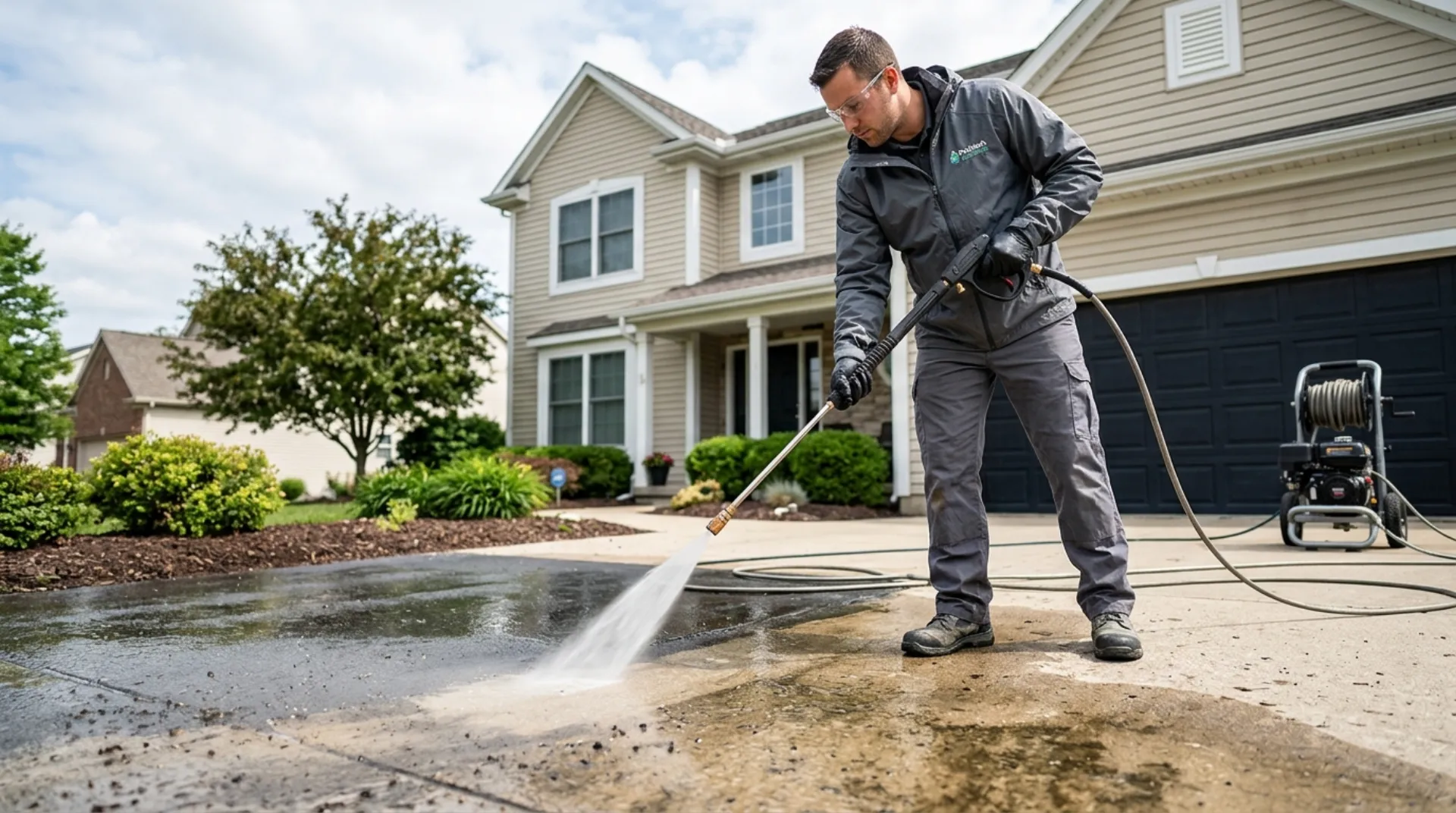
Pressure Washing Software,
$29/mo Flat.
· Pricing verified June 14, 2026
Send a per-square-foot bid with before/after photos from the trailer, take the mobilization deposit before you tow, see the moment the homeowner opens the estimate, and let Menutize text the customer a one-tap Google review link the second the driveway dries. $29/mo flat, one seat. Send 3 free quotes, then $29/mo to invoice and get paid.
$29/mo flat, one seat — teammates $15/seat, half of Jobber's $29/user.
3 free quotes, then $29/mo to invoice and get paid.
Pressure washing software, explained plainly
Menutize is pressure washing software for solo operators, soft-wash contractors, and small exterior-cleaning crews. It runs the office side of a wash business — customer CRM, per-square-foot photo estimates, mobilization deposit collection, online card and ACH payments, automated Google review requests, tip collection, recurring commercial wash billing, and two-way Google Calendar sync — for a flat $29/mo, one seat included — teammates $15/seat. Sign up free with no card, send 3 quotes, then $29/mo to invoice and get paid. See the $29/mo plan.
Pressure washing is a high-bid-volume, photo-driven, weather-and-season-sensitive trade, which is exactly why a free, payment-based tool fits it. A residential driveway or house wash runs from roughly a hundred dollars to a few hundred; a commercial flatwork or fleet-wash contract runs into the thousands and recurs every quarter. The tools that win those jobs are fast per-square-foot estimates with before/after photos that close on the homeowner's phone, mobilization deposits collected before the trailer rolls, and a steady flow of fresh Google reviews that keep you in the local Map Pack. Menutize was built around exactly those moments.
The paid platforms most pressure washing companies evaluate — Jobber, Housecall Pro, ServiceTitan, the exterior-cleaning CRM Markate, and the bidding tool ResponsiBid — almost all charge a monthly subscription and most charge per additional user (you get 14-day trials, sales demos, or in ResponsiBid's case a free quoting-only layer that still needs a paid CRM behind it). For a solo washer or a one-to-three person crew, those subscriptions add up to roughly $350–$3,600 per year before a single trailer rolls, often climbing further once a second or third login is added. Menutize is one flat $29/mo for one seat, plus $15/seat for teammates — sign up free, no card required, and the $29/mo only starts once you send your first invoice.
A growing share of homeowners now find pressure washers through an AI answer before they ever click a website — asking ChatGPT, Perplexity, or Google's AI Overviews "how much does it cost to pressure wash a driveway" or "best pressure washing near me." Those answers are assembled from structured, factual, citation-ready content and from your local presence: your Google Business Profile, your review count and recency, and your visibility in the Map Pack. So the two highest-return investments for a wash crew are now (1) a steady, automated flow of recent Google reviews and (2) fast, photo-rich estimates that convert the leads you do get. Menutize is built to drive both, which is why it fits where local search is heading better than a heavier platform that bills you monthly for dispatch features you will never open.
The rest of this page covers what is free, the four pressure-washing-specific workflows Menutize is built around, a full side-by-side comparison against Jobber, Housecall Pro, ServiceTitan, Markate, and ResponsiBid with verified 2026 pricing, a plain-language read on each competitor, real pressure-washing cost ranges, a five-question buying guide, a day-in-the-workflow walkthrough, an honest section on when a bigger platform fits, and the questions wash operators actually ask before signing up.
What's Included
Everything you need to run a pressure washing business — not a feature gated behind an upgrade. No credit card to start. No "trial expired" email in 14 days.
Customer CRM
Every customer, job, photo, and note in one place. Searchable. One seat included; teammates $15/seat.
Per-Square-Foot Photo Estimates
Branded estimates with unlimited before/after photos and tier pricing, sent from your phone. Customer approves with one tap.
Invoicing
Auto-generate clean invoices the moment a job closes. No separate QuickBooks license required.
Card & ACH Payments
Customers pay online. Money lands in 1-2 business days. ACH at 0.8% (capped at $5) is the cheap rail for big commercial balances.
Google Review Requests
Auto-text every happy customer a one-tap review link the moment you mark the job done.
Tip Collection
Built-in tip prompts at checkout. Crews actually keep the cash because tips route to the operator.
Built for the way pressure washing actually works.
Pressure washing isn't general handyman work. You're pricing per square foot on driveways, switching from soft wash to high pressure between siding and concrete, juggling Saturday residentials with Tuesday-morning gas station forecourts, and pulling a 7,000-lb trailer through neighborhoods where nobody warned you about the HOA. The $29/mo plan accounts for all of it.
Most "free" small-business software is a generic invoice template with a Stripe button bolted on. It works fine for a freelance designer and falls apart the second a property manager wants a recurring quarterly fleet wash bid with three different vehicle counts and a separate dumpster-pad line item. Menutize was built around the four workflows below — the ones that actually decide whether a pressure washing operation makes money this year or just runs the rig a lot.
Per-Square-Foot Bids with Before/After Photos
Menutize builds branded per-square-foot estimates with unlimited before/after photos, sent from your phone before you leave the driveway. Pressure washing closes on photos, not paragraphs: build an estimate with line items priced per square foot — driveway at $0.18/sqft, house wash at $0.22/sqft, deck soft wash at $0.45/sqft, fleet wash at $35/truck — attach the photos you took during the walkaround, and send it from your phone before you've left the driveway. Customers see a professional bid with the photos right next to the price and approve with one tap. Then offer side-by-side tiers on the same screen: house only, house plus driveway, or the whole exterior. The visual tier comparison does the up-sell work for you — when the value difference is on the spouse's screen at dinner instead of explained over the phone three hours earlier, more homeowners step up to the middle or top option. Photo upload is unlimited on the $29/mo plan, so you never ration shots on a big two-story house wash.
Estimate & Invoice Open-Tracking
Stop guessing which prospects ghosted and which never saw the bid. Menutize logs every estimate email open, every estimate page view, every invoice email open, and every invoice view, and notifies you the moment it happens. You see the homeowner opened the driveway bid three times in 20 minutes — that's the one to call right now. The other prospect never opened it — that's a deliverability problem, not a "they're thinking about it" problem. Pressure washing is a high-bid-volume trade where most operators send far more estimates than they close, so the difference between calling the warm prospect at the right moment and chasing the cold one for a week is real money. Most field-service tools either don't ship open-tracking or gate it behind their highest tier. Menutize ships it free.
Mobilization Deposits Before the Trailer Rolls
Menutize collects a mobilization deposit the moment the customer approves the bid, and the trailer doesn't roll until it clears. A 7,000-lb trailer doesn't tow itself for free, and a Saturday-morning ghost job costs you more than the lost revenue — it costs you the fuel, the prep time, and the 9am slot you turned down. Set a deposit percentage on each service tier (most operators use 25-50% on residential and a flat $250-$500 mobilization fee on commercial), and Menutize collects it the moment the customer approves the bid. The trailer doesn't roll until the deposit clears. Card and ACH both work, and ACH at 0.8% capped at $5 is the cheap rail on a big commercial deposit — on a $1,500 mobilization fee you pay $5 in ACH fees instead of roughly $44 on a card. Deposits credit straight against the final invoice when the job's done, so the customer feels great and you stop eating ghost-costs.
Recurring Quarterly Commercial Contracts
Menutize bills recurring quarterly and monthly commercial contracts automatically on the $29/mo plan. Residential pays the bills; commercial recurring pays the truck note. Set up a recurring service plan once — $450/quarter for a six-truck fleet wash, $180/month for a gas station forecourt and dumpster pad, $325/quarter for a strip-mall sidewalk — and Menutize charges the card on every renewal, schedules the visit on your Google Calendar, and emails the property manager a reminder the week of. A book of standing commercial contracts is the steadiest revenue a wash business can build — it's the cash flow that keeps the lights on through January when residential calls go quiet, and unlike the per-square-foot residential side, it's predictable revenue you don't have to re-sell every season. Recurring billing is on the $29/mo plan, not reserved for a paid tier.
Three Things Every Pressure Washing Pro Wishes They Had
Most "free" software either nags you to upgrade or leaves out the features that actually move the needle. Menutize makes the three biggest ones core to the $29/mo plan.
Auto Google Reviews
The moment you mark a pressure washing job complete, the customer gets a one-tap review link by text. No copy-paste, no "I'll do it later." Pressure washing is one of the fastest trades to climb the local Map Pack because the work is visually dramatic — the next homeowner is searching "pressure washing near me" and clicking the top three results. Review count and recency are among the strongest local-ranking signals, so automating the ask after every clean job compounds month over month — every job you finish becomes a shot at a fresh review instead of one you meant to ask for and forgot.
Included.
Tip Requests at Checkout
Customers see a 15/20/25% tip prompt right at payment — the same flow they're used to from Square or DoorDash. On a job where the homeowner just watched their gray driveway turn back to white, a tip is money most wash crews never even ask for, because there's no graceful way to do it face-to-face in the driveway. The prompt makes it effortless for them and tactful for you. No awkward ask, no cash changing hands in the driveway.
Included.
Google Calendar Two-Way Sync
Every booking lands in your real Google Calendar. Block time on your phone — water-reclamation training, equipment service, the drive to the dump — and Menutize won't let customers book over you. Jobber and Housecall Pro reserve their richer scheduling and calendar features for paid tiers; Menutize includes two-way Google Calendar sync for one flat $29/mo.
Included.
Menutize vs Jobber vs Housecall Pro vs ServiceTitan vs Markate vs ResponsiBid
A feature-by-feature comparison for pressure washing businesses, with pricing verified directly from each vendor's pricing page on June 14, 2026. Menutize is the only option with one flat $29/mo base price and a simple $15/seat add-on — half of Jobber's per-user ladder.
| Feature | Menutize | Jobber | Housecall Pro | ServiceTitan | Markate | ResponsiBid |
|---|---|---|---|---|---|---|
| Starting price | $29/mo flat | $29/mo annual ($49 m/m), Core | $59/mo annual ($79 m/m), Basic | Quote only ("Request Pricing") | $39.95/mo annual ($49.95 m/m), solo | $0/mo Startup (1 user) |
| Most-popular / mid tier | n/a — one flat plan | Grow $149–$299/mo annual ($199–$399 m/m) | Essentials $149/mo annual ($189 m/m) | Essentials — quote only | Team $39.95/mo annual + $5/employee | Scaling $179/mo |
| Top tier | n/a | Plus $529/mo annual ($699 m/m) | MAX $299/mo annual ($329 m/m) | The Works — quote only | Team + add-ons ($10–$50/mo each) | Pro $229/mo |
| Free, no-card signup | Yes — start free, no card | No (14-day trial) | No (14-day trial) | No (demo only) | No (14-day trial) | Yes (bidding only, 1 user) |
| Users included / add-on | $29 flat (1 seat) + $15/seat | 1–15 by tier; +$29/user/mo | 1–8 by tier; MAX +$35/user/mo | Per-technician pricing (quote) | Solo 1; Team +$5/employee/mo | 1 (Startup); unlimited sub-users (paid) |
| Annual contract required | No | No (annual prepay = lower price) | No (annual prepay = lower price) | Typically ~12-month contract | No (month-to-month, annual saves 20%) | No (month-to-month) |
| Per-square-foot photo estimates (before/after) | Yes, unlimited — free | Yes (paid plan) | Yes (paid plan) | Yes (mobile estimates, paid) | Yes (paid plan) | Quotes only (no full invoicing) |
| Tiered estimate options (house / house + driveway / full exterior) | Yes — free | Via custom line items (paid) | Via custom line items (paid) | Via pricebook (paid) | Via line items (paid) | Yes (quoting calculator) |
| Estimate & invoice open-tracking | Yes — free | Higher tier | Higher tier | Yes (paid plan) | Limited | Follow-up only (paid) |
| Mobilization deposit collection | Yes (card & ACH) — free | Yes (paid plan) | Yes (paid plan) | Yes (paid plan) | Yes (e-payments, paid plan) | Via connected CRM |
| ACH at 0.8% (capped $5) | Yes — free | Card-focused; varies | Card-focused; varies | Varies | Varies | Via connected CRM |
| Recurring quarterly commercial billing | Yes (card on file) — free | Yes (paid plan) | Yes (paid plan) | Yes (memberships, paid) | Yes (paid plan) | No (not a billing tool) |
| Automated Google review requests | Yes — free | Add-on / higher tier | Higher tier | Yes (marketing module, paid) | Add-on | Via NiceJob integration (Pro) |
| Tip collection at checkout | Yes — free | Rarely supported | Rarely supported | Rarely supported | Rarely supported | No |
| Two-way Google Calendar sync | Yes — free | Higher tier | Higher tier | Yes (paid plan) | Yes (paid plan) | No (via connected CRM) |
| Online booking page | Yes — free | Yes (paid plan) | Yes (paid plan) | Yes (paid plan) | Add-on ($10/mo) | Yes (quote widget) |
| Soft-wash vs high-pressure service menu (per-service pricing) | Yes — build per-service line items & tiers, free | Via custom line items (paid) | Via custom line items (paid) | Via pricebook (paid) | Via line items (paid) | Yes (auto-upsell, even on free) |
| Full back office in one tool | Yes | Yes | Yes | Yes | Yes | No (bidding layer; needs a CRM) |
| Est. 1st-year software cost (1 owner + 1 helper) | $348 | ~$348+ (Core annual; +$29/mo 2nd user) | ~$708+ (Basic annual; 2nd user needs Essentials ~$1,788) | Quote only (3rd-party est. $245–$500/tech/mo + implementation) | ~$479+ (solo annual) / ~$539+ Team (+$5/employee) | $0 (Startup) / ~$2,148+ (Scaling) on top of a CRM |
Pricing verified from each vendor's official pricing page on June 14, 2026. Jobber: Core $29/mo annual ($49 month-to-month), Connect $99–$149/mo annual, Grow $149–$299/mo annual, Plus $529/mo annual; +$29/user/mo; 14-day trial only. Housecall Pro: Basic $59/mo annual ($79 m/m), Essentials $149/mo annual ($189 m/m), MAX $299/mo annual ($329 m/m, +$35/extra user); 14-day trial only. ServiceTitan: tier names Starter / Essentials / The Works are published but no dollar figures are; pricing is per-technician and quote-only after a sales demo. Third-party estimates ($245–$500/tech/mo plus a one-time implementation fee) are unverified and shown for context only. Markate: Owner Operator (solo) $39.95/mo annual ($49.95 m/m), Team from $39.95/mo annual ($49.95 m/m) + $5/mo per additional employee, optional add-ons $10–$50/mo; 14-day trial, no free plan. ResponsiBid: Startup $0/mo (1 user, quoting only), Scaling $179/mo, Pro $229/mo; ResponsiBid is a bidding/follow-up layer and integrates with a separate CRM rather than replacing one. Card-processing fees apply on all platforms; Menutize is a flat $29/mo (one seat; $15/seat per teammate) plus standard Stripe processing rates, with no added percentage fee. First-year estimates assume Menutize's flat $29/mo for 12 months and annual-prepay pricing for competitors, and exclude processing or implementation fees.
Menutize vs each platform, in plain language
The table above is the quick scan. Here is the honest, vendor-by-vendor read for a pressure washing owner deciding where to put the office work — what each tool costs, who it's actually for, and where Menutize wins or loses.
Menutize vs Jobber
Jobber is the default starter platform for home-services trades, and it's a solid product. The friction for a wash shop is the pricing ladder. Core is $29/mo on an annual plan ($49 month-to-month) but includes only one user. The popular Grow tier — the one Jobber's own trial drops you into — runs $149–$299/mo annually ($199–$399 month-to-month) and includes ten users, and the top Plus tier is $529/mo annually. Every additional user beyond a plan's cap is $29/mo. There is no free-forever plan; you get a 14-day trial and then the card is charged.
For a one-to-three person pressure washing business, the math rarely favors Jobber. A solo operator who just needs per-square-foot photo estimates, mobilization deposits, recurring commercial billing, reviews, and a calendar is paying $348/yr minimum on Core, or stepping up to Grow's four-figure annual cost for features Menutize includes in its flat $29/mo. Menutize matches Jobber on the core wash workflow — photo estimates, tiered options, online payments, scheduling, recurring agreements — and adds estimate open-tracking, tip collection, and Google review automation on the same plan rather than gating them. Pick Jobber if you want its broader integrations ecosystem and don't mind the subscription. Pick Menutize if you want the same job-winning workflow for one flat $29/mo base — plus $15/seat, half of Jobber's per-user bill.
Menutize vs Housecall Pro
Housecall Pro is polished and popular with residential service businesses. Its Basic plan is $59/mo annually ($79 month-to-month) for a single user, Essentials is $149/mo annually ($189 month-to-month) for up to five users, and MAX is $299/mo annually ($329 month-to-month) for up to eight users with additional MAX seats at $35/mo each. Like Jobber, there is no free tier — only a 14-day trial.
The catch for a small wash crew is that the single-user Basic plan is thin for a crew operation, so most shops that need multiple logins land on Essentials at roughly $1,788/yr. That's a meaningful fixed cost for a business whose revenue swings with the seasons and goes near-zero in a cold-climate winter. Menutize gives an owner-plus-helper one seat on the $29/mo base plus a $15/seat add-on — still about half of Housecall Pro's per-user cost — and includes the review automation and open-tracking Housecall Pro reserves for higher tiers. Pick Housecall Pro if you specifically want its consumer-financing and marketing add-ons. Pick Menutize if you want to avoid Housecall Pro's per-user costs and run the same daily workflow on one flat price.
Menutize vs ServiceTitan
ServiceTitan is the enterprise standard for large field-service operations, and it's genuinely powerful. It does not publish prices: the Starter, Essentials, and The Works tiers each show a "Request Pricing" button, pricing is per-technician and quote-only after a sales demo, and no free trial length is stated. Unverified third-party reports place it at roughly $245–$500 per technician per month, usually on a 12-month contract plus a one-time implementation fee that can run from $5,000 to $50,000 or more.
That cost structure makes sense for a 20-truck operation with a dispatch desk, fleet tracking, and board-level reporting — and it's overkill, financially and operationally, for a wash shop running a trailer and a surface cleaner. ServiceTitan is the rare competitor we'll actively point you toward: if you've crossed into multi-crew enterprise scale, it earns its price. Below that scale, Menutize covers the job-winning workflow without a contract, an implementation project, or a per-technician bill. Pick ServiceTitan if you're a large operation. Pick Menutize if you're not yet one.
Menutize vs Markate
Markate is the most exterior-cleaning-native of the full CRMs here — pressure-washing, window, and gutter crews use it heavily. Its Owner Operator (solo) plan is $39.95/mo billed annually ($49.95 month-to-month), and its Team plan starts at $39.95/mo annually ($49.95 month-to-month) plus $5/mo per additional team member. The thing to watch is the add-on stack: online booking ($10/mo), the AI receptionist, and various integrations ($10–$50/mo each) are paid extras on top of the base plan, so a fully-featured Markate setup costs more than the headline. There's a 14-day trial but no free-forever plan.
For a two-person wash crew, Markate lands around $479/yr for the solo base, more once you add the helper seat and the booking add-on. Menutize covers the same exterior-cleaning workflow — per-square-foot photo estimates, recurring commercial billing, payments, calendar — and includes online booking, review automation, tip collection, and open-tracking in the same plan with no per-employee fee. Pick Markate if you want its specific add-on ecosystem and don't mind assembling it. Pick Menutize if you want the booking page, reviews, and recurring billing in the base product for one flat $29/mo — one seat included, teammates $15/seat.
Menutize vs ResponsiBid
ResponsiBid is different from the others — it's not a full CRM, it's a quoting-and-follow-up layer that a lot of pressure-washing and exterior-cleaning crews bolt onto a separate back office. It's arguably the best-known bidding calculator in the wash world, and it integrates with Jobber, Housecall Pro, and Markate. Its Startup plan is genuinely free for one user (quoting calculator, multiple service tiers, auto-upsell), which is a real strength for building a sharp on-site per-square-foot bid. But the automated follow-up and CRM connections that make it worth running live on the Scaling plan at $179/mo or the Pro plan at $229/mo.
Because ResponsiBid is a bidding layer, you still need invoicing, payments, scheduling, recurring commercial billing, and reviews from another tool — which means stacking its $179–$229/mo on top of a Jobber or Markate subscription. Menutize gives you the full back office — tiered photo estimates with side-by-side options, payments, recurring billing, calendar, and review automation — in one place for one flat $29/mo — one seat included, teammates $15/seat. Pick ResponsiBid if you specifically love its quoting calculator and already pay for a CRM you're happy with. Pick Menutize if you'd rather not pay for a separate bidding subscription on top of everything else.
What pressure washing actually costs — and how to quote it fast
Pressure washing price depends on square footage, surface type (concrete vs siding vs roof), the pressure level the surface can take, the amount of organic growth or staining, access and height, and whether water reclamation is required on commercial flatwork. The ranges below reflect typical U.S. cost guidance — use them as a starting framework, then build your own per-service line items into a Menutize service menu so you can quote on-site in two taps.
| Job type | Typical U.S. range | What moves the number |
|---|---|---|
| Driveway / concrete (high pressure) | $0.15–$0.25 / sqft ($100–$250 typical) | Square footage, depth of staining (oil, rust, organic), and whether a surface cleaner can run flat or needs detailing on edges and cracks. |
| House wash (soft wash) | $0.15–$0.40 / sqft ($250–$600 typical) | Stories and access, siding material, and the amount of mildew/algae; two-story and dense growth push toward the top of the range. |
| Roof wash (soft wash, low pressure) | $0.30–$0.60 / sqft | Pitch, height, and the black-streak (Gloeocapsa) load; low-pressure chemical wash is the standard to protect shingles. |
| Deck / fence (low pressure + brightener) | $0.40–$0.60 / sqft | Wood vs composite, the brightener/stain-prep step, and whether sealing is bundled as a separate line. |
| Commercial flatwork / fleet (recurring) | $180–$450+ / visit, often quarterly | Vehicle count or pad square footage, water-reclamation requirements, and contract frequency; the predictable recurring base of the business. |
These are illustrative industry ranges, not Menutize quotes — your real numbers depend on your market, your equipment, your chemical costs, and the specific property. The point is structural: pressure washing pricing has enough variables (square footage, surface, pressure level, growth load, access) that a verbal phone number a homeowner half-remembers loses to an on-site per-square-foot estimate with the dirty-driveway photo attached. In Menutize, set up "Driveway / concrete," "House wash (soft wash)," "Roof wash," "Deck / fence," and "Commercial recurring" as menu items with your own per-square-foot base rates, then adjust per job and attach photos before you send.
The same logic applies to the bundles and recurring contracts that decide whether a pressure washing year is steady or feast-or-famine. The house-plus-driveway bundle is the easiest add-on to present, and it converts far better as a visible side-by-side tier — house only vs house plus driveway vs the whole exterior — with a before photo than as a verbal pitch from the driveway. On the recurring side, commercial flatwork, fleet washes, and dumpster-pad contracts (monthly or quarterly) are the predictable revenue base that carries you through winter. Rather than re-sell each commercial customer every quarter, set the agreement once and let the card on file and the calendar do the work. Tiered, photo-backed estimates and standing recurring agreements consistently outperform one-off verbal quotes in this trade, because the value comparison is on the customer's screen and the next visit is already booked and paid.
How to choose pressure washing software
Most buying guides bury the decision under a feature checklist. For a pressure washing business, five questions settle it. Answer these and the right tool is usually obvious.
1. How visual and bid-heavy is the work?
Extremely. The before/after is the entire sales pitch, and you send far more estimates than you close. That makes per-square-foot photo estimates, side-by-side tiers, and open-tracking the single highest-leverage features — far more important than dispatch routing or fleet tracking for a small shop. Any tool you pick must let you attach unlimited photos, present options the customer approves from a phone, and tell you the moment a bid gets opened.
2. How seasonal is your revenue?
For most operators, very — especially in cold climates where the freeze months are dead. A per-user subscription that keeps climbing is a worse fit for a small, seasonal crew than a flat base price with a low, capped per-seat add-on. This is the core reason Menutize's flat $29/mo base — plus just $15/seat for each teammate, half of Jobber's or Housecall Pro's per-user rate — fits pressure washing better than Jobber's, Housecall Pro's, or Markate's per-user pricing for a small operator.
3. How many people need a login?
Count the owner, the second-truck lead, the helper, and the bookkeeper. On per-seat platforms that's $29–$35 per extra user per month (Jobber, Housecall Pro MAX) or $5/employee on Markate Team, on top of the base plan. If more than one or two people touch the system, a low flat per-seat add-on changes the total cost materially — which is where Menutize's $15/seat, half of Jobber's $29/user, pulls ahead.
4. Do you depend on Google reviews to get found?
If "pressure washing near me" is how customers find you — and for most local shops it is — then automated post-job review requests are not optional. Review volume and recency drive the local Map Pack, and pressure washing climbs it fast because the work photographs so well. A tool that fires a one-tap review link the moment you mark a job complete, included rather than bolted on as a paid add-on, compounds your local ranking month after month.
5. Do you need enterprise routing or a standalone bidding calculator?
This is the honest dividing line. If you're a 20+ truck operation needing dispatch, routing, and board-level reporting, ServiceTitan is built for that. If you specifically want a dedicated quoting-and-follow-up calculator and already pay for a CRM, ResponsiBid layers on top. If you're neither — a solo-to-small wash crew — you don't need either, and a free tool that nails the estimate-deposit-review loop in one place is the smarter call.
The right pick by business stage
You + a helper
You're the tech, salesperson, and dispatcher. You need fast per-square-foot estimates, mobilization deposits, reviews, and a calendar — not a dispatch board. Menutize covers all of it for one flat $29/mo, one seat included — teammates are $15/seat as you add a helper.
Multiple trucks, one owner
Now you're coordinating crews and equipment and giving several people logins. Per-seat fees start to bite on the paid platforms. Menutize still fits — $15/seat per teammate, crew/rig tagging, recurring commercial contracts — for one flat $29/mo base, half of Jobber's per-user rate.
$5M+, 20+ trucks
Dispatch desk, fleet tracking, payroll and commission automation, board-level reporting. This is where a free tool stops being enough. ServiceTitan is the right investment at this scale; if you just want a dedicated bidding calculator on top of a CRM, ResponsiBid fits there.
A day in the workflow
Here is how a pressure washing operator runs a Saturday on Menutize: shoot before photos on-site, send a tiered per-square-foot bid from the phone, collect the deposit, schedule the job to a tagged rig, then auto-request a Google review and a tip the moment the job is marked complete.
It's 7:30am on a Saturday in spring and you've got three estimates booked before noon. First stop is a gray, algae-streaked driveway and a single-story house the homeowner wants brightened up before a graduation party. Instead of scribbling measurements on a coffee-cup sleeve, you add the customer in Menutize, walk the property, and shoot before photos — the worst stretch of the driveway, the mildew on the north siding, the back patio nobody mentioned.
From your phone you build the estimate with three tiers: house only, house plus driveway, and the whole exterior including the patio and walkway. Each line is priced per square foot off your service menu. You attach the photos, set the deposit at 30%, and send it before you're back in the truck. By the time you reach the second stop, Menutize has already notified you the homeowner opened the estimate twice — and tapped the house-plus-driveway tier, the middle option, which is exactly what the visible side-by-side comparison is built to do.
The second job is a commercial one: a property manager wants a recurring quarterly wash on a gas station forecourt and dumpster pad. You set it up as a $325/quarter recurring contract with a $250 mobilization fee, card on file, scheduled automatically every three months. The third is a quick deck soft wash you quote standard and move on.
Mid-morning the first homeowner pays the 30% deposit by card; the job locks onto next Tuesday's calendar, tagged to the surface-cleaner trailer so it won't collide with the soft-wash rig already booked that day. The deposit means the trailer doesn't roll on a maybe — you're already paid to hold the slot.
Tuesday the crew turns the driveway from gray back to white and softwashes the house clean. You mark the job complete from the field; the auto Google review request texts the homeowner a one-tap link while you're still loading hoses, and the tip prompt is right there on the payment screen — the homeowner who just watched the transformation adds 20%. By Wednesday morning you've got a new five-star review with a before/after the customer posted themselves, a paid invoice, an unexpected tip, and a recurring commercial contract on the books — all run from a phone, on Menutize's flat $29/mo base — just $15/seat for each extra person on the crew who needs a login.
When not to use Menutize for pressure washing
Menutize is the wrong tool for a large exterior-cleaning operation; it's built for solo operators and small-to-mid crews, roughly one trailer up to a handful of rigs. If you're running $5M+ in annual revenue, 20+ field trucks, a full-time dispatcher, and you need GPS truck tracking, automated multi-crew route optimization, call-center integration, commission and payroll automation, and board-level financial reporting, you should look at a heavier platform like ServiceTitan or Jobber's higher tiers. That depth is exactly what their per-technician, quote-only pricing and implementation onboarding are designed to deliver, and it will pay for itself at that scale.
A few other honest limits: Menutize does not auto-file stormwater or water-reclamation paperwork (it stores the reclamation status, photos, and waste logs on the job record, but the filing is on you), it is not a chemical-inventory or SDS-management system, and it is not a full accounting suite — it exports clean CSVs but won't replace deep QuickBooks job-costing history. If your business depends on a dedicated quoting calculator you already love, ResponsiBid layers on top of a CRM for exactly that.
For everyone else — the owner who is also the tech, the estimator, and the bookkeeper — Menutize covers the workflow that wins jobs for one flat $29/mo. Send 3 free quotes, then $29/mo to invoice and get paid — move up only if you actually outgrow it.
Why the free-plan math works in this trade
Three things the public data makes clear about pressure-washing economics — and why a flat $29/mo base with a capped $15/seat add-on for reviews and deposits built in is a structural advantage over uncapped per-seat pricing, not a gimmick.
Per-user subscription creep you avoid
The range of first-year base subscription fees across Jobber and Housecall Pro tiers, with Markate adding $479+/yr plus per-employee fees (verified pricing pages, June 2026). Menutize's flat $29/mo base plus a capped $15/seat per teammate means you stop paying Jobber- or Housecall-Pro-level per-user rates every time you add a login.
Where homeowners click
Review count, rating, and recency are among the heaviest local-ranking factors for "pressure washing near me" searches, per published local-SEO research, and those searches are dominated by Google's Map Pack. Automated review requests after every job — on a trade whose before/after photographs beautifully — are the cheapest way to climb it.
Half of Jobber's per-user rate
Paid platforms charge $29–$35 per extra user per month (Jobber, Housecall Pro MAX) or $5/employee on Markate Team. Menutize's $29/mo flat base includes one seat, and each teammate after that is just $15/seat — about half what Jobber charges per user.
Figures above are composites drawn from public vendor pricing pages (verified June 14, 2026) and published local-SEO research, not testimonials from named businesses. Your results depend on your market, your pricing, and how consistently you use the review and estimate tools.
Pressure Washing Software Questions, Answered
The ones operators actually ask before they sign up.
How much does Menutize cost for pressure washing businesses? What's the catch?
How does Menutize compare to Jobber for pressure washing?
How does Menutize compare to Housecall Pro for pressure washing?
How does Menutize compare to ServiceTitan for pressure washing?
How does Menutize compare to Markate for pressure washing?
How does Menutize compare to ResponsiBid for pressure washing?
Can I send per-square-foot estimates with before/after photos?
Can I see when a customer opens my estimate?
Can I take a mobilization deposit before I tow the trailer?
How do I manage recurring quarterly commercial wash contracts?
Can I do soft-wash and power-wash as separate services with different pricing?
Does Menutize sync with my Google Calendar?
How does the automated Google review request work?
Can my customers tip me through Menutize?
Can I tag jobs by crew, truck, or trailer?
Can I store warranty terms and recurring records on each customer?
Does it work for solo operators and seasonal businesses in cold climates?
How much does Menutize actually cost?
What happens to my customer data if I leave Menutize?
Pressure washing software, done honestly.
Per-square-foot estimates with photos, mobilization deposits, recurring commercial contracts, Google reviews, tips, calendar — all on the $29/mo plan for one seat — teammates $15/seat. Setup takes 10 minutes. 3 free quotes, then $29/mo to invoice and get paid.
Start free — $29/mo when you sendSet up in 10 minutes. 3 free quotes, then $29/mo to invoice and get paid. Cancel anytime, no contract. See the $29 plan