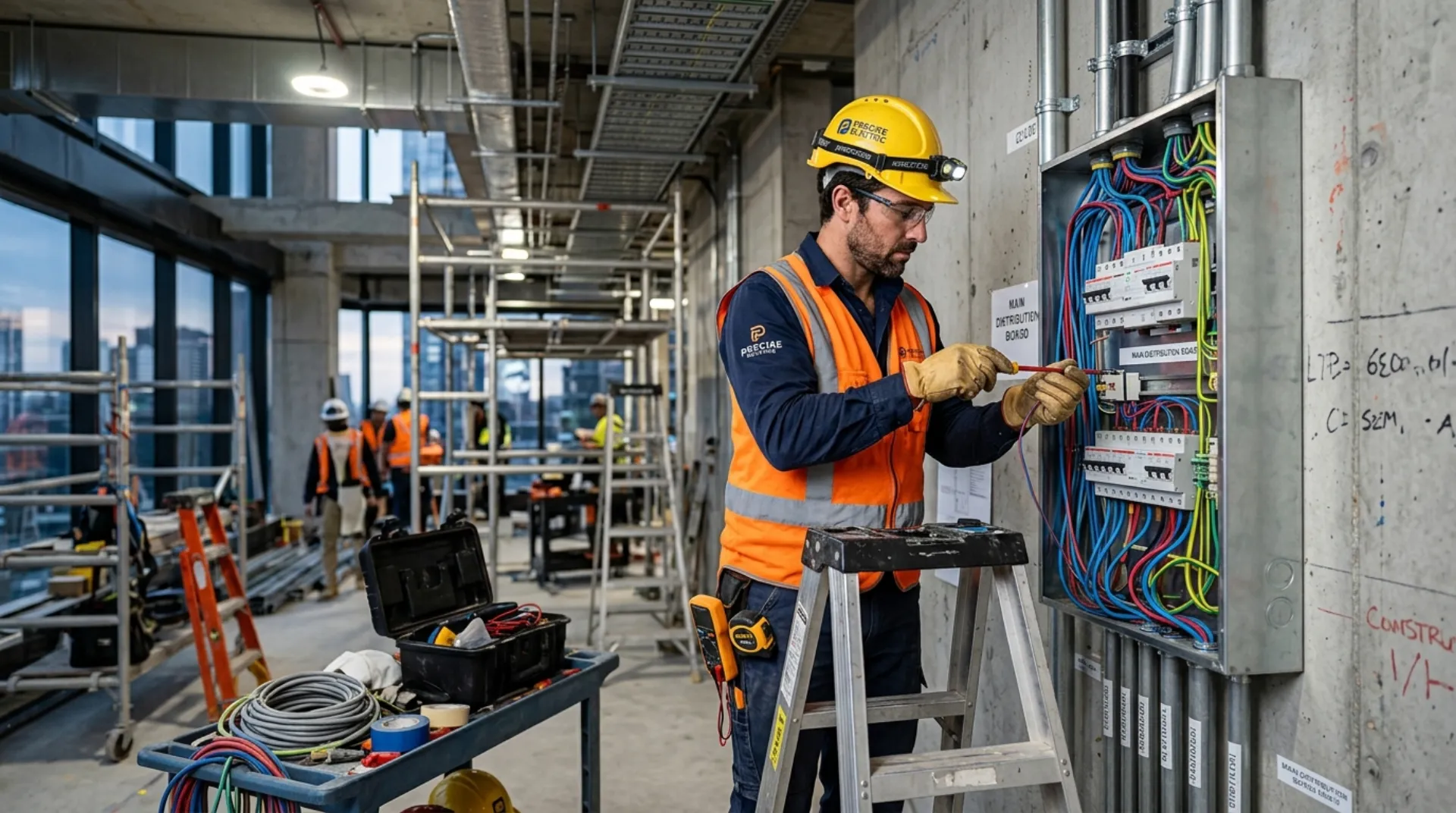
Electrical Software,
$29/mo Flat.
· Pricing verified June 14, 2026
Send a panel-upgrade estimate with three tiers from the truck, see the moment the homeowner opens it, collect a deposit before you order the load center, and have Menutize text the customer a one-tap Google review link the day you mark the job done. $29/mo flat. One seat, +$15/seat. Start free.
CRM, invoicing & payments — one flat $29/mo for one seat, teammates just $15/seat (half of Jobber's $29/user), no tier upgrades like Housecall Pro & Service Fusion.
Electrician software, explained plainly
Menutize is $29/mo flat electrician software for solo electricians, master and journeyman electricians, and small electrical contractors. It runs the office side of an electrical business — customer CRM, panel-upgrade and EV-charger estimates with photos and tiered options, deposit and milestone (progress-draw) invoicing, online card and ACH payments, automated Google review requests, tip collection, recurring commercial-inspection billing, and two-way Google Calendar sync — for one flat $29 per month for a single seat, with additional teammates at $15/seat. There is no per-job fee, and you can sign up free with no card to explore, then pay $29/mo when you send your first invoice.
That matters in this trade because electrical work spans two very different ticket sizes. A normal residential week is four small service calls (an outlet that won't work, a ceiling fan, a smoke detector) at $85-$350 each, then one big-ticket job — an EV-charger install, a $1,800 panel upgrade, or a whole-house rewire that can run to five figures. Then somebody trips the hot-tub GFCI on a Saturday and that's an after-hours call at a premium. The same software has to send a two-tap service invoice and a three-tier panel-upgrade proposal with a compliant deposit, and most generic "free" tools do neither well. Menutize was built around exactly those moments.
The platforms most electricians evaluate — ServiceTitan, Jobber, Housecall Pro, FieldPulse, and Service Fusion — all charge a monthly subscription or gate pricing behind a sales quote, most charge per additional user, and none offer a genuine free-forever plan (only 14-day trials or demos). For a one-to-three person electrical shop, the entry floors run from $29/mo (Jobber) and $59/mo (Housecall Pro) up to $208/mo (Service Fusion), with ServiceTitan reaching a public year-one estimate of $35,000-$65,000+ once implementation and contracts are counted. Menutize is one flat $29/mo instead — one seat, every feature included, extra teammates at $15/seat — so your office software stays a small, predictable line item even in a slow week.
One more shift worth naming: how electrical customers find you is changing. A growing share of homeowners now start with an AI answer — asking ChatGPT, Perplexity, or Google's AI Overviews "how much to upgrade a 100-amp panel to 200" or "best electrician near me" — before they ever click a website. Those answers are assembled from structured, factual, citation-ready content and from your local presence: your Google Business Profile, your review count and recency, and your visibility in the local Map Pack. For an electrical shop the two highest-return investments are (1) a steady, automated flow of recent Google reviews and (2) fast, photo-rich estimates that convert the leads you do get. Menutize is built to drive both, which is why it fits where local search is heading better than a heavier platform that bills you monthly for dispatch features you'll never open.
The rest of this page covers what's included, the four electrical-specific workflows Menutize is built around, a full side-by-side comparison against ServiceTitan, Jobber, Housecall Pro, FieldPulse, and Service Fusion with verified 2026 pricing, a plain-language read on each competitor, real electrical cost ranges and deposit rules (including California's deposit cap and Florida's permit/start-deadline rule), a five-question buying guide, a day-in-the-workflow walkthrough, an honest section on when a bigger platform is the right call, and the questions electricians actually ask before signing up.
What's Included
Everything you need to run an electrical contracting business — not a feature gated behind an upgrade. No credit card to start. No "trial expired" email in 14 days.
Customer CRM
Every customer, job, photo, permit number, and note in one place. Searchable. One seat included; add teammates at $15/seat.
Estimates & Tiered Quotes
Branded panel-upgrade and EV-charger estimates with photos and side-by-side options. Customer approves with one tap.
Deposit & Milestone Invoicing
Collect a compliant deposit, then bill progress draws at rough-in, trim-out, and final. No QuickBooks license required.
Card & ACH Payments
Customers pay online. Money lands in 1-2 business days. ACH at 0.8% (capped at $5) is the cheap rail for big panel balances.
Google Review Requests
Auto-text every happy customer a one-tap review link the moment you mark the job done.
Tip Collection
Built-in tip prompts at checkout. Common on the $250 fix-an-outlet trip, money that was never on the table before.
Built for the way electrical work actually flows.
Electrical isn't general handyman work. You're triaging a tripping breaker at 9pm, quoting a $4,000 panel upgrade against two other electricians, juggling a new-construction rough-in on a six-month timeline, and bringing an apprentice on the job. The $29/mo plan accounts for all of it.
Most contractor software is a general field-service tool with the word "electrical" stamped on the marketing page — the workflows and line items are identical and you're paying $49 to $79 a month for a generic CRM with a different home-page screenshot. Electrical has its own rhythms: small service tickets, big-ticket proposals, after-hours surge pricing, multi-phase draws, and state-regulated deposits. Menutize was built around the four workflows below: the ones that actually decide whether your shop closes the panel upgrade that pays for the month or watches it walk to the next electrician in the search results.
Big-Ticket Panel Upgrade & EV-Charger Estimates with Tier Pricing
Panel upgrades run roughly $1,200-$2,000 — a 100A-to-200A upgrade commonly $1,800-$3,500 — whole-house rewires $1,500-$10,000, and EV-charger installs are a fast-growing high-demand ticket. These aren't service-call tickets, they're proposals, and the homeowner is shopping you against two other electricians. Build a digital estimate with photos and three side-by-side options (100A like-for-like, 200A upgrade, 200A with whole-home surge protection and a generator interlock), the homeowner taps the option they want and signs from their phone, and Menutize collects the deposit before you order the load center. The value comparison lives on the customer's screen at dinner instead of read out loud over the phone — which consistently nudges more homeowners to the middle or top tier.
Deposit & Milestone Billing (State-Rule Aware)
On small electrical jobs a 33-50% deposit is common; on large jobs a 10-20% deposit followed by milestone draws tied to completed phases is the norm. State law can change that: California actually caps a home-improvement deposit at 10% of the contract or $1,000, whichever is less (jobs over $500), so a flat 50% deposit can be illegal there. Florida doesn't cap the deposit, but under Fla. Stat. 489.126 a residential contractor who takes more than 10% upfront has to pull permits within 30 days and start work within 90 days. Menutize lets you set a compliant deposit and then bill progress draws — a common structure is 40% rough-in / 40% trim-out / 20% on inspection — as separate payment links the customer taps from a phone. The cash lands in phases, and the final invoice auto-generates when the inspection passes.
Emergency Service Calls with After-Hours Rates
A breaker tripping at 9pm with half the kitchen dark is the call you want — but only if the rate matches the inconvenience. Industry guidance puts a normal service call or trip fee at $100-$200, with after-hours, weekend, and holiday work adding a $100-$200 premium on top of standard rates. Set a separate after-hours menu item (a higher trip charge plus a higher hourly rate for nights and weekends) and Menutize swaps the pricing in automatically based on the booking time. The customer sees the after-hours rate before they book, so there's no awkward conversation when you arrive at 11pm, and the surge pricing turns the free-quote calls that used to go nowhere into paid work.
Apprentice & Journeyman Crew Coordination
Most one-truck electricians become two-truck operations the first time an apprentice earns their journeyman card. When that happens you want each tech to have their own login, their own slice of the Google Calendar, and their own assigned jobs without seeing the bookkeeping side. Tag each job with the tech running it and the truck assigned, and the calendar shows each person's week cleanly while the owner keeps the master view. Because Menutize's teammate seats are just $15/mo on the flat $29 base, the apprentice, the journeyman, the sub on a big rewire, and the bookkeeper each add a small, predictable $15 — versus the $29/user (Jobber) or $35/user (Housecall Pro MAX) the paid platforms charge beyond their included seats.
Three Things Every Electrician Wishes They Had
Most "free" software either nags you to upgrade or leaves out the features that actually move the needle. Menutize makes the three biggest ones core to the plan.
Auto Google Reviews
The moment you mark an electrical job complete, the customer gets a one-tap review link by text. No copy-paste, no "I'll do it later." Electrical runs almost entirely on Google reviews and the local Map Pack — the next homeowner with a dead circuit is searching "electrician near me" and clicking the top three results. Review count and recency are among the strongest local-ranking signals, so automating the ask after every clean job compounds month over month.
Included.
Tip Requests at Checkout
Customers see a 15/20/25% tip prompt right at payment — the same flow they're used to from Square or DoorDash. Tips skew toward the smaller, personal jobs: a homeowner whose nuisance-tripping outlet you fixed in twenty minutes often wants to say thanks, and the prompt makes it effortless for them and tactful for you. Less common on the $5K panel upgrade, more common on the $250 service trip — either way, money that was never on the table before.
Included.
Google Calendar Two-Way Sync
Every booking lands in your real Google Calendar. Block time on your phone — supply-house run, CEU code class, kid's game — and Menutize won't let customers book over you. Jobber and Housecall Pro reserve their richer scheduling for paid tiers; Menutize includes two-way Google Calendar sync at $29/mo flat.
Included.
Menutize vs ServiceTitan vs Jobber vs Housecall Pro vs FieldPulse vs Service Fusion
A feature-by-feature comparison for electrical contractors, with pricing verified directly from each vendor's pricing page on June 14, 2026. Menutize is the only option with one flat $29/mo base price and $15 teammate seats.
| Feature | Menutize | ServiceTitan | Jobber | Housecall Pro | FieldPulse | Service Fusion |
|---|---|---|---|---|---|---|
| Starting price | $29/mo flat | Quote only ("Request Pricing") | $29/mo annual ($49 m/m), Core | $59/mo annual ($79 m/m), Basic | Quote only (seat-based) | $208/mo annual ($245 m/m), Starter |
| Most-popular / mid tier | n/a — one flat $29 plan | Essentials — quote only | Grow $149–$299/mo annual ($199–$399 m/m) | Essentials $149/mo annual ($189 m/m) | Professional — quote only | Plus $325/mo annual ($382 m/m) |
| Top tier | n/a | The Works — quote only | Plus $529/mo annual ($699 m/m) | MAX $299/mo annual ($329 m/m) | Enterprise — quote only | Pro $533/mo annual ($627 m/m) |
| $29/mo, 1 seat (+$15/seat) | Yes | No (demo only) | No (14-day trial) | No (14-day trial) | No (no trial stated) | No (demo only) |
| Users included / add-on | $29/mo, 1 seat (+$15/seat) | Per-technician pricing (quote) | 1–15 by tier; +$29/user/mo | 1–8 by tier; MAX +$35/user/mo | Full vs Field-only seats (quote) | Unlimited users, all tiers |
| Annual contract required | No | Typically ~12-month contract | No (annual prepay = lower price) | No (annual prepay = lower price) | Quote-dependent | No (annual prepay = lower price) |
| Self-serve sign-up (no demo) | Yes — no card | No (sales demo) | Yes (trial) | Yes (trial) | No (quote) | No (demo) |
| Photo estimates & tiered options | Yes, unlimited — included | Yes (mobile estimates, paid) | Yes (paid plan) | Yes (paid plan) | Yes (paid plan) | Yes (flat-rate, paid plan) |
| Deposit & milestone (progress-draw) billing | Yes (card & ACH) — included | Yes (paid plan) | Yes (paid plan) | Yes (paid plan) | Yes (paid plan) | Yes (progress billing, paid) |
| After-hours / surge service pricing | Yes — included | Via pricebook (paid) | Via custom line items (paid) | Via custom items (paid) | Via custom items (paid) | Via flat-rate book (paid) |
| Estimate & invoice open-tracking | Yes — included | Yes (paid plan) | Higher tier | Higher tier | Varies | Varies |
| ACH at 0.8% (capped $5) | Yes — included | Varies | Card-focused; varies | Card-focused; varies | Varies | Varies |
| Automated Google review requests | Yes — included | Yes (marketing module, paid) | Add-on / higher tier | Higher tier | Varies | Varies |
| Tip collection at checkout | Yes — included | Rarely supported | Rarely supported | Rarely supported | Rarely supported | Rarely supported |
| Two-way Google Calendar sync | Yes — included | Yes (paid plan) | Higher tier | Higher tier | Yes (paid plan) | Yes (paid plan) |
| Recurring commercial-inspection billing | Yes — included | Yes (memberships, paid) | Yes (paid plan) | Yes (paid plan) | Yes (paid plan) | Yes (paid plan) |
| Electrical estimating depth (NEC takeoff, wire/conduit DB) | No (cedes to ConEst / McCormick) | Yes (NEC-aware pricebook) | No | No | No | No |
| Est. 1st-year software cost (1 owner + 1 apprentice) | $348/yr flat (1 seat; +$15/seat) | Quote only (3rd-party est. $245–$500/tech/mo + $5K–$50K implementation; public year-1 est. $35K–$65K+) | ~$696+ (Core annual + $29/mo 2nd user) | ~$1,788+ (Essentials annual, 2nd user needs it) | Quote only (seat-based) | ~$2,496+ (Starter annual, unlimited users) |
Pricing verified from each vendor's official pricing page on June 14, 2026. ServiceTitan: tier names Starter / Essentials / The Works are published but no dollar figures are; pricing is per-technician and quote-only after a sales demo, typically on a ~12-month contract. Third-party estimates ($245–$500/tech/mo plus a one-time $5,000–$50,000+ implementation fee, public year-one totals of $35,000–$65,000+) are unverified and shown for context only. Jobber: Core $29/mo annual ($49 month-to-month, 1 user), Connect $99–$149/mo annual ($139–$199 m/m, 5 users), Grow $149–$299/mo annual ($199–$399 m/m, 10 users), Plus $529/mo annual ($699 m/m, 15 users); +$29/user/mo; 14-day trial only. Housecall Pro: Basic $59/mo annual ($79 m/m, 1 user), Essentials $149/mo annual ($189 m/m, up to 5 users), MAX $299/mo annual ($329 m/m, up to 8 users, +$35/extra user); 14-day trial only. FieldPulse: quote-only, seat-based (Full-access vs Field-only seats across Essentials / Professional / Enterprise); no public dollar figures and no free trial stated on the pricing page. Service Fusion: Starter $208/mo annual ($245 m/m), Plus $325/mo annual ($382 m/m), Pro $533/mo annual ($627 m/m), with unlimited users on every tier; "Get a Free Demo," no free trial or freemium stated. Card-processing fees apply on all platforms; Menutize uses standard Stripe rates on payments processed. First-year estimates assume annual-prepay pricing and do not include processing or implementation fees.
Menutize vs each platform, in plain language
The table above is the quick scan. Here is the honest, vendor-by-vendor read for an electrical contractor deciding where to put the office work — what each tool costs, who it's actually for, and where Menutize wins or loses.
Menutize vs ServiceTitan
ServiceTitan is the category's deepest, most trade-specific platform — it has a dedicated electrical vertical with an NEC-aware pricebook, dispatch, financing, memberships, commission tracking, and agentic AI. It is the default for established shops running 20+ techs with office staff, and the brand authority and integration depth are real. It also does not publish prices: the Starter, Essentials, and The Works tiers each show a "Request Pricing" button, pricing is per-technician and quote-only after a sales demo, with no free tier and no stated trial.
Unverified third-party reports place it at roughly $245–$500 per technician per month, usually on a 12-month contract plus a one-time implementation fee of $5,000–$50,000 or more, with public year-one estimates of $35,000–$65,000+. That structure makes sense for a multi-truck operation; it is massively over-priced and over-built for a solo-to-small electrician, and the quote-only wall, high-pressure sales, and non-cancelable contracts are recurring public complaints from small shops. Pick ServiceTitan if you've crossed into multi-crew enterprise scale and need NEC-aware estimating, dispatch, and board-level reporting. Pick Menutize if you run one to a handful of trucks and want the estimate-deposit-invoice-review loop at $29/mo flat, self-serve, and contract-free.
Menutize vs Jobber
Jobber is the most-recommended starter platform for small electrical operations, and it's a solid product with a clean UX and a frictionless trial. The friction for an electrician is the pricing ladder. Core is $29/mo annual ($49 month-to-month) but includes only one user. The popular Grow tier — the one Jobber's own trial drops you into — runs $149–$299/mo annually ($199–$399 month-to-month) and includes ten users, and the top Plus tier is $529/mo annually ($699 month-to-month). Every additional user beyond a plan's cap is $29/mo. There is no free-forever plan; you get a 14-day trial and then the card is charged.
For a one-to-three person electrical shop the math rarely favors Jobber. A solo electrician who needs photo estimates, deposits, reviews, and a calendar pays $348/yr minimum on Core, and real usefulness for a small team (5 users, automations) jumps to roughly $99–$149/mo. Menutize matches Jobber on the core electrical workflow — photo estimates, tiered options, deposits, online payments, scheduling — and adds estimate open-tracking, tip collection, and Google review automation included rather than gating them. Pick Jobber if you want its broader integrations ecosystem and don't mind the subscription. Pick Menutize if you want the same job-winning workflow at $29/mo flat, with $15 teammate seats.
Menutize vs Housecall Pro
Housecall Pro is frequently rated a top pick for electrical contractors — polished consumer-grade booking, payments, marketing, and review automation, and it owns a lot of the home-services brand mindshare. Its Basic plan is $59/mo annually ($79 month-to-month) for a single user, Essentials is $149/mo annually ($189 month-to-month) for up to five users, and MAX is $299/mo annually ($329 month-to-month) for up to eight users with extra MAX seats at $35/mo each. Like Jobber, there is no free tier — only a 14-day trial.
The catch for a small electrical shop is that single-user Basic is too thin for a crew, so most shops that need multiple logins land on Essentials at roughly $1,788/yr — the highest small-shop floor of the mainstream self-serve three. That's a meaningful fixed cost for a business whose revenue swings with the season. Menutize gives an owner-plus-apprentice two seats for $44/mo ($29 base plus one $15 seat) and includes the review automation and open-tracking Housecall Pro reserves for higher tiers. Pick Housecall Pro if you specifically want its consumer-financing and marketing add-ons. Pick Menutize if you want to keep most of that $360–$1,440/yr and run the same daily workflow for one flat $29/mo.
Menutize vs FieldPulse
FieldPulse explicitly markets an electrician vertical, has a well-reviewed mobile app, strong work-order/estimate/dispatch coverage, and a cheaper "field-only" seat tier aimed at smaller teams — it's positioned as the affordable-but-capable middle option for a growing electrical shop. The problem for a price-shopping electrician is that its pricing is gated. There are no public dollar amounts: the model is seat-based (Full-access vs Field-only seats across Essentials, Professional, and Enterprise tiers), "pricing is customized to your team size and setup — contact us for a quote," and no free trial is stated on the page.
That quote wall is exactly the friction Menutize removes. The newly-licensed electrician who "just wants to sign up and invoice this job today without talking to sales" can't do that with FieldPulse — they have to book a call before they can even see a number. Pick FieldPulse if you want its field-only seat model and don't mind a sales conversation to get pricing. Pick Menutize if you want to sign up, send an estimate, and get paid in the next hour at $29/mo flat, no quote required.
Menutize vs Service Fusion
Service Fusion is marketed directly to electricians and its headline differentiator is genuinely attractive: unlimited users on every tier, with no per-user charges, so adding apprentices and techs never inflates the bill. It has solid dispatch, flat-rate pricing, QuickBooks sync, and job costing. Its published tiers are Starter at $208/mo annually ($245 month-to-month), Plus at $325/mo annually ($382 month-to-month), and Pro at $533/mo annually ($627 month-to-month). There is no free tier — it offers a free demo, but no free trial or freemium.
The catch is the floor. A $208/mo entry price — the highest of any self-serve option here — makes little sense for a 1-2 person electrical business; the unlimited-user value only pays off at scale, when you've got enough techs that per-seat fees on Jobber or Housecall Pro would have cost more. A new or solo electrician is priced out. Menutize also starts at one flat $29/mo with teammate seats at $15, so it captures the small operator Service Fusion can't, and grows with them. Pick Service Fusion if you're already running enough techs that its unlimited-user model beats per-seat platforms and you want its dispatch/flat-rate depth. Pick Menutize if you're a solo-to-small shop that wants a low base and cheap seats without a $200+/mo floor.
One thing Menutize does not do
Menutize does not compete on heavy electrical-estimating depth — NEC takeoff, conduit and wire databases, labor-unit calculators for commercial bidding. That's the domain of specialist tools like ConEst IntelliBid and McCormick, and ServiceTitan's NEC-aware pricebook on the enterprise end. If you're a commercial shop bidding large conduit-and-feeder jobs off blueprints, you need one of those, and Menutize won't replace it. What Menutize owns is the money side of a small electrical business — fast photo estimates, deposits, milestone draws, invoicing, payments, reviews, and calendar — at $29/mo flat. We're explicit about ceding heavy commercial bidding rather than pretending to cover it.
What electrical work actually costs — and how to quote it fast
Electrical spans tiny service tickets and five-figure rewires, so a single rate card never fits. The ranges below reflect typical 2026 U.S. cost guidance (Housecall Pro and HomeGuide) — use them as a starting framework, then build your own line items into a Menutize service menu so you can quote on-site in two taps.
Service calls & hourly rates
| Line item | Typical U.S. range | What moves the number |
|---|---|---|
| Service call / trip fee | $100–$200 | Billed separately from hourly; usually covers the first 30–60 minutes on site. HomeGuide cites $75–$150. |
| After-hours / weekend / holiday premium | +$100–$200 | Added on top of standard rates for nights, weekends, and holidays. |
| Apprentice hourly | $40–$60/hr | Lowest billed labor; rising in 2026 with the labor shortage. |
| Journeyman hourly | $60–$90/hr | HomeGuide cites up to $100/hr. Composite homeowner-billed rate ~$50–$130/hr. |
| Master electrician hourly | $90–$150/hr | Highest billed labor; demand up with EV-charger, panel, and backup-power work. |
Common job tickets
| Job | Typical U.S. range | Notes |
|---|---|---|
| Switch / outlet install or replace | $85–$300 | Switch $85–$200; outlet $200–$300. Classic small service ticket. |
| Ceiling fan / light fixture | $140–$6,000 | Fan $140–$350; fixture $150–$6,000 (chandeliers and high ceilings drive the top). |
| Panel upgrade | $1,200–$2,000 | HomeGuide $850–$2,500; 100A→200A upgrade $1,800–$3,500 (6–10 hrs). |
| Whole-house rewire | $1,500–$10,000 | Multi-phase job — the textbook case for milestone draws. |
| Dedicated circuit / hot-tub wiring | $300–$2,400 | Dedicated circuit $570–$1,000; hot-tub circuit/wiring runs ~$300–$1,600, with 220V or sub-panel installs reaching $2,000+. |
| EV charger install & outdoor lighting | High-demand / $2,000–$6,000 | EV charger is a fast-growing high-demand ticket; outdoor lighting $2,000–$6,000. |
Deposits, milestones & the state rules that change the math
Deposit norms in electrical work split by job size. On small jobs (e.g. a panel rewire) a 33%–50% deposit before you show up is common; on large jobs (a $100K reno) a 10%–20% deposit is more typical, followed by milestone payments tied to completed phases and a final payment on approval. The standard structure is deposit → milestone draws → final payment.
State law matters and it changes the math. California is the one that actually caps the deposit: it limits a home-improvement deposit to 10% of the contract price or $1,000, whichever is less, on qualifying jobs over $500. So in California the common 33%–50% deposit can be illegal on a qualifying job — you'd structure it as a small compliant deposit plus milestone draws instead. Florida is different: Fla. Stat. 489.126 doesn't cap the deposit at all, but a residential contractor who collects more than 10% of the contract price upfront must apply for permits within 30 days and start the work within 90 days — an obligation, not a ceiling. Menutize's deposit and milestone invoicing handles either case: set the deposit you need, then bill progress draws (a common pattern is 40% rough-in / 40% trim-out / 20% on inspection) as the work completes.
Profit margin. Housecall Pro's 2026 guidance puts the target at 10%–20% per job. Tiered, photo-backed estimates protect that margin: when a homeowner can see a 100A like-for-like option next to a 200A upgrade with surge protection, more of them choose up, and the average ticket rises without a hard sell.
The point is structural: electrical pricing has too many variables — load, run length, panel condition, permit fees, after-hours timing, and state deposit law — to quote reliably over the phone. That's exactly why on-site, photo-backed estimates with pre-built line items and a compliant deposit close more work than a verbal number a homeowner half-remembers. In Menutize, set up "Service call," "After-hours service call," "Panel upgrade," "EV charger install," "Whole-house rewire," and "Recurring commercial inspection" as menu items with your own base prices, attach photos, set the deposit, and send before you leave the driveway. (Seasonality is not well-quantified in published sources; anecdotally electrical demand is steadier than HVAC but spikes with storm/outage season for backup power and panels and with summer EV/AC-load upgrades — treat that as a hypothesis, not a verified pattern.)
How to choose electrician software
Most buying guides bury the decision under a feature checklist. For an electrical business, five questions settle it. Answer these and the right tool is usually obvious.
1. How big-ticket and visual is the average job?
Electrical is both small-ticket and big-ticket. The money jobs — panel upgrades, EV chargers, rewires — run from four to five figures, and the homeowner is comparing you against two other electricians on price and trust. That makes photo estimates with side-by-side tiered options the single highest-leverage feature, far more important than dispatch routing for a small shop. Any tool you pick must let you attach photos to an estimate and present options the homeowner can approve from a phone.
2. Do your big jobs need deposits and milestone draws — legally?
If you do panel upgrades and rewires, yes. You need to collect a deposit before ordering materials and bill progress draws as phases complete — and if you work in California your deposit is legally capped at 10% or $1,000, whichever is less. (Florida doesn't cap the deposit, but taking more than 10% upfront triggers a 30-day permit / 90-day start deadline under Fla. Stat. 489.126.) A tool that only does a single flat invoice forces you to improvise. Menutize's deposit-plus-milestone billing is built for compliant, phased collection.
3. How many people need a login?
Count the owner, the apprentice, the journeyman, and the bookkeeper. On per-seat platforms that's $29–$35 per extra user per month on top of the base plan; Service Fusion bundles unlimited users but only above a $208/mo floor. Menutize charges $15 per extra seat — roughly half of Jobber's or Housecall's per-user fee — on the flat $29 base, so an owner-plus-apprentice runs $44/mo total. That lower per-seat rate changes the total cost materially — which is where Menutize pulls ahead.
4. Do you depend on Google reviews to get found?
If "electrician near me" is how customers find you — and for most local shops it is — then automated post-job review requests are not optional. Review volume and recency drive the local Map Pack. A tool that fires a one-tap review link the moment you mark a job complete, included rather than bolted on as a paid add-on, compounds your local ranking month after month.
5. Do you need heavy commercial estimating or enterprise tooling?
This is the honest dividing line. If you bid large commercial conduit-and-feeder jobs off blueprints and need NEC takeoff and wire/labor-unit databases, you need ConEst, McCormick, or ServiceTitan's NEC-aware pricebook. If you're a 20+ tech operation needing dispatch, routing, and board-level reporting, ServiceTitan is built for that. If you're neither — a solo-to-small residential and light-commercial shop — you don't need either, and a free tool that nails the estimate-deposit-invoice-review loop is the smarter call.
The right pick by business stage
Just went out on your own
You're the master electrician, the salesperson, and the dispatcher. You need fast photo estimates, deposits, reviews, and a calendar — not a dispatch board. Menutize covers all of it at one flat $29/mo — a fraction of what the tiered platforms charge at your volume.
Owner + apprentice / journeyman
Now you're coordinating techs and trucks and giving several people logins. Per-seat fees start to bite on the paid platforms. Menutize still fits — a $29 base seat plus $15 teammates, crew/truck tagging, milestone draws, recurring commercial inspections — well under the per-seat platforms.
20+ techs or heavy bidding
Dispatch desk, fleet tracking, NEC takeoff off blueprints, commission and payroll automation. This is where a free tool stops being enough. ServiceTitan (enterprise dispatch + NEC pricebook) or specialist estimators like ConEst / McCormick are the right investment at this scale.
A day in the workflow
It's 7:50am and your phone is already going. A homeowner across town has a panel that's tripping under load and wants a quote on a 200-amp upgrade; two other electricians are coming Thursday. You're pulling on boots, so instead of writing the address on a parts receipt you add the customer in Menutize on the way to the truck. Two more calls come in before nine — a dead bedroom circuit and a Saturday hot-tub GFIC that keeps tripping — and they land on your Google Calendar without colliding with the new-construction trim-out already scheduled for tomorrow.
At the panel job you open the cover, photograph the cramped 100-amp service and the rusted bus, and build the estimate on your phone with three tiers: 100A like-for-like, 200A upgrade, and 200A with whole-home surge protection and a generator interlock. You attach the photos, and because this customer is in California you set the deposit at the legal cap — $1,000 — rather than a flat 50%, with the balance billed as a draw on inspection. You send it before you're back in the truck. By the time you reach the dead-circuit call, Menutize has notified you the homeowner opened the estimate twice.
The dead-circuit fix is a thirty-minute service ticket; you invoice it from the field at your standard service-call rate, the customer pays by card on the spot, and the tip prompt at checkout adds twenty bucks you weren't expecting. Mid-morning the panel-upgrade homeowner taps the middle tier — the 200A upgrade — and pays the $1,000 deposit by ACH; the $5 cap means you keep nearly the whole deposit instead of losing card points on a four-figure number. The job locks onto next week's calendar, tagged to you and the apprentice.
The day you do the upgrade, you mark it complete from the field. The auto Google review request texts the homeowner a one-tap link while you're still labeling breakers, and the final-draw invoice generates the moment the inspector signs off. The Saturday hot-tub call stays on the calendar as its own job, after-hours rate already applied, so it bills clean on its own.
By the end of the week you've got a new five-star review, a paid panel upgrade collected in two compliant phases, a tip the apprentice helped earn, and a recurring strip-mall inspection contract you set up on the drive home — all run from a phone on one flat $29/mo base, no per-job surprises.
When not to use Menutize for electrical
Menutize is built for solo electricians and small-to-mid residential and light-commercial shops — roughly one to a handful of trucks. It is honestly the wrong tool for a large operation. If you're running 20+ field techs, a full-time dispatch desk, and you need GPS fleet tracking, automated multi-crew routing, call-center integration, commission and payroll automation, and board-level financial reporting, you should look at ServiceTitan, whose NEC-aware electrical vertical and per-technician, quote-only pricing are designed for exactly that scale.
Likewise, if your business depends on heavy commercial estimating — NEC takeoff off blueprints, conduit and wire databases, labor-unit calculators for competitive feeder-and-distribution bids — that's the domain of specialist tools like ConEst IntelliBid and McCormick, and Menutize does not replicate it. We cede heavy commercial bidding on purpose rather than pretend to cover it.
For everyone else — the owner-operator who is also the master electrician, salesperson, and dispatcher — Menutize covers the workflow that wins and bills jobs at $29/mo flat. Start free, and move up only if you actually outgrow it.
Why the flat-$29 math works in this trade
Three things the public data makes clear about electrical-business economics — and why a $29/mo flat tool with reviews and deposits built in is a structural advantage, not a gimmick.
What the tiered platforms charge/yr
The range of first-year base subscription fees across Jobber, Housecall Pro, and Service Fusion (verified pricing pages, June 2026) — before ServiceTitan's quote-only $35K–$65K+ year-one estimates. Menutize is one flat $29/mo ($348/yr) for one seat, with extra teammates at just $15/seat, so your software bill sits at the bottom of that range and stays low even as you add an apprentice.
Where homeowners click
Local "electrician near me" searches are dominated by Google's Map Pack, where review count, rating, and recency are among the heaviest ranking factors per published local-SEO research. Automated review requests after every job are the cheapest way to climb it.
Per-seat cost as you add apprentices
Paid platforms charge $29–$35 per extra user per month (Jobber, Housecall Pro MAX); Service Fusion bundles unlimited users only above a $208/mo floor. Menutize's extra seats are $15/mo on the flat $29 base — about half of Jobber's or Housecall's per-user fee — so adding an apprentice is a small, predictable bump.
Figures above are composites drawn from public vendor pricing pages (verified June 14, 2026), published electrical cost guidance (Housecall Pro, HomeGuide), and published local-SEO research — not testimonials from named businesses. Your results depend on your market, your pricing, and how consistently you use the review and estimate tools.
Electrical Software Questions, Answered
The ones electricians actually ask before they sign up.
Is Menutize really $29/mo flat for electricians? What's the catch?
What's the best free invoicing software for a solo electrician just starting out?
How does Menutize compare to Jobber for electrical?
How does Menutize compare to Housecall Pro for electrical?
Is ServiceTitan worth it for a small 2-3 person electrical shop, or is it overkill?
Jobber vs Housecall Pro vs FieldPulse for an electrical contractor — which is cheapest?
How much should I charge for a service call as an electrician in 2026?
What deposit percentage should I ask for on a panel upgrade — and is 50% legal in California?
Can Menutize send panel-upgrade and EV-charger estimates with photos and tiered options?
Can I bill a whole-house rewire in milestones or progress payments?
What's the cheapest way to accept credit card payments from electrical customers?
How long does setup take, and how much does Menutize cost?
Great electrical software, one flat $29/mo.
Panel-upgrade estimates, compliant deposits, milestone draws, after-hours dispatch, Google reviews, tips, calendar — all included in one flat $29/mo for one seat (teammates $15/seat). Setup takes 10 minutes. Start free, no card.
Start free — no credit cardSet up in 10 minutes. Explore free, then $29/mo when you send your first invoice. No contract, cancel anytime.