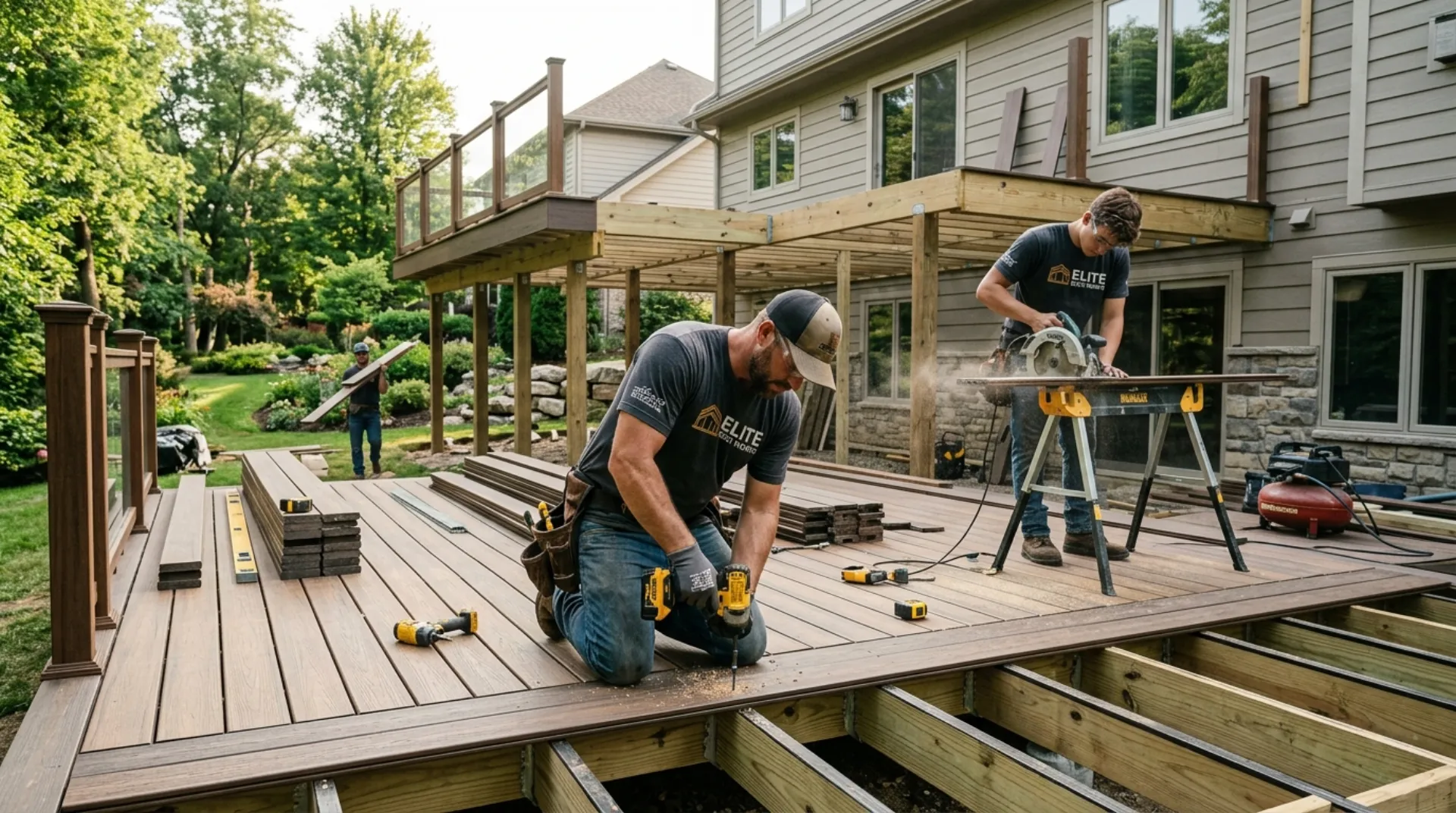
Deck Building Software,
$29/mo Flat.
· Pricing verified June 14, 2026
Send a $40K composite-deck estimate with three material tiers and backyard photos from the truck, see the moment the homeowner opens it, collect a 33% deposit before the lumber order goes in, draw on framing day, and have Menutize text the homeowner a one-tap Google review link the moment final inspection passes. $29/mo flat — one seat, +$15/seat. Start free.
CRM, invoicing & payments — one flat $29/mo for one seat (+$15/seat). no per-job fees or tier upgrades like Jobber, Housecall Pro, Buildertrend & CompanyCam.
Deck building software, explained plainly
Menutize is $29/mo flat deck building software for residential deck builders, outdoor-living contractors, and composite-decking installers. It runs the office side of a deck business — customer CRM, three-tier photo estimates, big-ticket invoicing, deposit and draw collection, online card and ACH payments, automated Google review requests, tip collection, a date-stamped progress-photo log, and two-way Google Calendar sync — for one flat $29/mo for one seat, teammates $15/seat. There is no per-job fee, and you can sign up free with no card to explore, then pay $29/mo when you send your first invoice.
That matters in this trade because deck building is high-ticket and slow to decide. A single new build runs from a few thousand dollars for a small pressure-treated platform to $40,000 or more for a large composite deck with railings, lighting, and a pergola, and the homeowner often deliberates for weeks with a spouse before signing. The tools that win those jobs are three-tier estimates that let the customer compare materials visually and close on their own phone, deposits collected before the lumber order goes in, draws that hit on framing day, and a steady flow of fresh Google reviews from neighbors who watched the build go up. Menutize was built around exactly those moments.
The paid platforms most deck companies evaluate — Jobber, Housecall Pro, the enterprise ServiceTitan, the construction-management Buildertrend, and the photo app CompanyCam — all charge a monthly subscription, most charge per additional user, and none offer a genuine free-forever plan (only 14-day trials or sales demos). For a solo deck builder or a one-to-three crew shop, those subscriptions add up to anywhere from a few hundred to several thousand dollars a year before a single deck board is fastened. Menutize is one flat $29/mo instead — one seat (+$15/seat), every feature included — so your office software stays a single predictable line item even in the slow winter months.
One more shift worth naming: how deck customers find you is changing. A growing share of homeowners now start with an AI answer — asking ChatGPT, Perplexity, or Google's AI Overviews "how much does a composite deck cost" or "best deck builder near me" — before they ever click a website. Those answers are assembled from structured, factual, citation-ready content and from your local presence: your Google Business Profile, your review count and recency, and your visibility in the Map Pack. The practical takeaway for a deck shop is that the two highest-return investments are (1) a steady, automated flow of recent Google reviews and (2) fast, photo-rich, three-tier estimates that convert the leads you do get. Menutize is built to drive both, which is why it fits where local search is heading better than a heavier platform that bills you monthly for project-management features a small shop will rarely open.
The rest of this page covers what's included, the four deck-specific workflows Menutize is built around, a full side-by-side comparison against Jobber, Housecall Pro, ServiceTitan, Buildertrend, and CompanyCam with verified 2026 pricing, a plain-language read on each competitor, real deck-building cost ranges by material, a five-question buying guide, a day-in-the-workflow walkthrough, an honest section on when a bigger platform is the right call, and the questions deck operators actually ask before signing up.
What's Included
Everything you need to run a residential deck-building business — not a feature gated behind an upgrade. No credit card to start. No "trial expired" email in 14 days.
Customer CRM
Every homeowner, deck, photo, permit number, and warranty note in one place. Searchable. one seat (+$15/seat).
Three-Tier Photo Estimates
Send branded PT / cedar / composite estimates with backyard photos from your phone. Customer compares all three and approves with one tap.
Invoicing
Auto-generate clean invoices the moment a deck closes or a draw is due. No separate QuickBooks license required.
Card & ACH Payments
Homeowners pay deposits and draws online. Money lands in 1-2 business days. ACH at 0.8% (capped at $5) is the cheap rail for big draws.
Google Review Requests
Auto-text every happy homeowner a one-tap review link the moment final inspection passes.
Tip Collection
Built-in tip prompts at checkout. The crew sees the upside of a clean build and a happy homeowner.
Built for the way deck building actually works.
Deck building isn't general handyman work. You're sending $15K-$60K estimates with three material tiers, fronting four-figure composite orders before a deck board lands, sequencing footing/framing/final inspections, fighting frost depth on northern footings, and waiting weeks while the homeowner deliberates with a spouse. The $29/mo plan accounts for all of it.
A $42,000 composite build with a spouse who reopens the estimate at 9pm is not the same job as a Saturday gutter clean, and your software shouldn't pretend it is. Most "free" small-business tools are an invoice template with a Stripe button bolted on — fine for a freelance designer, useless when a homeowner is comparing your cedar tier against a second contractor's composite quote at the kitchen table. Menutize was built around the four workflows below: the ones that actually decide whether a deck shop closes the build that pays for the quarter or watches it walk to the next operator in the search results.
Three-Tier Material Pricing on Every Estimate
Per-square-foot pricing varies wildly by material — pressure-treated runs roughly $30-$45/sf installed, cedar lands at $40-$60/sf, composite jumps to $50-$80/sf, and IPE or other tropical hardwoods push past $65-$100/sf. Send one estimate with all three options side by side: PT (basic), cedar (mid), composite (premium), with brand-tier callouts for Trex Transcend or TimberTech AZEK on the top option. The homeowner sees materials, warranty terms, and total price for every tier on one screen, taps the option they want, signs, and pays the deposit from their phone. Operators report homeowners self-select up to the mid or premium tier far more often when the options are visual and compared at dinner instead of read out loud over the phone three hours earlier. Three-tier estimates are included on Menutize; most competitors gate richer estimating behind a paid tier.
Estimate & Invoice Open-Tracking
A $40K composite estimate sitting unread is a different problem than one the homeowner has opened four times but hasn't signed. The first needs a nudge; the second needs a phone call today, because a homeowner who keeps coming back to your quote is showing you a buying signal you used to be blind to. Menutize logs the moment the customer opens the estimate email and every time they reopen the live estimate page, then notifies you. Same tracking on each invoice and draw through to the moment they pay. You stop guessing whether the spouse has seen the quote, you stop chasing leads who already signed with a competitor, and your follow-up call lands at the right time on the right people. Most field-service tools gate open-tracking behind a higher tier; Menutize ships it included.
Deposit + Draw Schedule Collection
A composite deck takes weeks, runs five figures in materials before a single deck board lands, and the legacy way to collect — chase a check between phases — is how cash-flow problems start. Menutize handles a 33-50% deposit on contract, a framing-day or material-delivery draw, and a final balance as separate payment links the homeowner taps from their phone. Card or ACH; ACH is the cheaper rail for big draws at 0.8% capped at $5 (versus 2.9% + 30¢ on cards), so on a $20,000 balance you pay $5 instead of roughly $580. Collecting the deposit before the lumber order goes in means you're never financing the homeowner's build out of your own pocket. Educate the customer once on the ACH route and never chase a check again.
Multi-Angle Photos + Build-Progress Log
Deck estimates live or die on photos: existing patio, sight lines, grade, where the stair stringer lands, where the railing meets the door header. Snap them from the backyard, drop them into the estimate, and the homeowner sees what you saw. Once the build starts, every progress photo — footings poured, ledger flashed, frame up, decking down, railing set — gets stamped with the date and the uploading user, all on the customer's record. Send the homeowner two progress shots a week and they stay calm during the long stretches when nothing visible is happening. This is the same documentation job many builders pay CompanyCam $63-$199/mo for, included here at no extra cost — and it doubles as the social-proof library that fuels the neighbor-referral pipeline of people walking by who watched the build go up.
Three Things Every Deck Building Pro Wishes They Had
Most "free" software either nags you to upgrade or leaves out the features that actually move the needle. Menutize makes the three biggest ones core to the plan.
Auto Google Reviews
The moment you mark a deck job complete, the homeowner gets a one-tap review link by text. No copy-paste, no "I'll do it later." Decks are visible from the street and the neighbor's yard, so review volume compounds with the social proof of the finished build itself. Review count and recency are among the strongest local-ranking signals, and the next homeowner searching "deck builder near me" is clicking the top three Map Pack results — automating the ask after every job is one of the highest-leverage things a small deck shop can do.
Included.
Tip Requests at Checkout
Customers see a tip prompt right at payment — the same flow they're used to from Square or DoorDash. Deck tips skew bigger than restaurant tips: a happy homeowner on a $40K composite build frequently leaves $200-$500 for the crew when the prompt is on the screen and nobody has to ask awkwardly at handoff. No cash changing hands in the driveway, no uncomfortable moment — just an easy way for a thrilled customer to thank the carpenters who built their backyard.
Included.
Google Calendar Two-Way Sync
Multi-week build dates, footing inspections, and material-delivery slots all land in your real Google Calendar. Block time on your phone — lumberyard pickup, inspector window, vacation week — and Menutize won't let homeowners book over you. Jobber and Housecall Pro both reserve their richer scheduling for paid tiers; Menutize includes two-way Google Calendar sync at $29/mo flat.
Included.
Menutize vs Jobber vs Housecall Pro vs ServiceTitan vs Buildertrend vs CompanyCam
A feature-by-feature comparison for deck building businesses, with pricing verified directly from each vendor's pricing page on June 14, 2026 (Buildertrend publishes no figures; see notes). Menutize is the only option with one flat $29/mo price (one seat, teammates $15/seat).
| Feature | Menutize | Jobber | Housecall Pro | ServiceTitan | Buildertrend | CompanyCam |
|---|---|---|---|---|---|---|
| Starting price | $29/mo flat | $29/mo annual ($49 m/m), Core | $59/mo annual ($79 m/m), Basic | Quote only ("Request Pricing") | Quote only (volume-based) | $63/mo annual, Core (1 user) |
| Most-popular / mid tier | n/a — one flat $29 plan | Grow $149–$299/mo annual ($199–$399 m/m) | Essentials $149/mo annual ($189 m/m) | Essentials — quote only | Quote only (3rd-party est. ~$699–$799/mo) | Crew $129/mo annual (3 users) |
| Top tier | n/a | Plus $529/mo annual ($699 m/m) | MAX $299/mo annual ($329 m/m) | The Works — quote only | Quote only (3rd-party est. ~$829–$1,099/mo) | Scale $199/mo annual (3 users) |
| one flat $29/mo for one seat (+$15/seat) | Yes | No (14-day trial) | No (14-day trial) | No (demo only) | No (demo only) | No (free trial) |
| Users included / add-on | 1 seat incl., +$15/seat | 1–15 by tier; +$29/user/mo | 1–8 by tier; MAX +$35/user/mo | Per-technician pricing (quote) | Unlimited users (vendor states) | 1–3 by tier; +$29/user/mo |
| Annual contract required | No | No (annual prepay = lower price) | No (annual prepay = lower price) | Typically ~12-month contract | Annual prepay = 10% off | No (annual prepay = lower price) |
| Three-tier material estimates | Yes — included | Yes (paid plan) | Yes (paid plan) | Yes (paid plan) | Yes (paid plan) | No (photo app, not estimating) |
| Multi-angle photo upload | Yes, unlimited — included | Yes (paid plan) | Yes (paid plan) | Yes (paid plan) | Yes (paid plan) | Yes (its core feature, paid) |
| Estimate & invoice open-tracking | Yes — included | Higher tier | Higher tier | Yes (paid plan) | Limited | No |
| Deposit + draw collection | Yes (card & ACH) — included | Yes (paid plan) | Yes (paid plan) | Yes (paid plan) | Yes (payments / draws, paid) | No |
| ACH at 0.8% (capped $5) | Yes — included | Card-focused; varies | Card-focused; varies | Varies | Varies | No payments |
| Automated Google review requests | Yes — included | Add-on / higher tier | Higher tier | Yes (marketing module, paid) | Limited / add-on | No |
| Tip collection at checkout | Yes — included | Rarely supported | Rarely supported | Rarely supported | Rarely supported | No |
| Two-way Google Calendar sync | Yes — included | Higher tier | Higher tier | Yes (paid plan) | Yes (scheduling, paid) | No |
| Customer-visible progress photo log | Yes, date-stamped — included | Limited | Limited | Yes (paid plan) | Yes (paid plan) | Yes (its core feature, paid) |
| 3D deck designer / CAD | No (use free Trex/TimberTech tools) | No | No | No | Selections / takeoff (paid) | No |
| Per-material line items (PT / cedar / composite / IPE) | Yes — build material line items in your menu & tiers, included | Via custom line items (paid plan) | Via custom line items (paid plan) | Via pricebook (paid plan) | Via estimating / takeoff (paid plan) | No (photo app) |
| Est. 1st-year software cost (1 owner + 1 carpenter) | $348/yr flat (1 seat; +$15/seat) | ~$696+ (Core annual + $29/mo 2nd user) | ~$708+ (Basic annual; 2nd user needs Essentials ~$1,788) | Quote only (3rd-party est. $245–$500/tech/mo + implementation) | Quote only (3rd-party est. ~$4,000–$13,000+/yr) | ~$1,548 (Crew annual, 3 users) — photos only |
Pricing verified from each vendor's official pricing page on June 14, 2026, except where noted. Jobber: Core $29/mo annual ($49 month-to-month), Connect $99–$149/mo annual, Grow $149–$299/mo annual, Plus $529/mo annual; +$29/user/mo; 14-day trial only. Housecall Pro: Basic $59/mo annual ($79 m/m), Essentials $149/mo annual ($189 m/m), MAX $299/mo annual ($329 m/m, +$35/extra user); 14-day trial only. ServiceTitan: tier names Starter / Essentials / The Works are published but no dollar figures are; pricing is per-technician and quote-only after a sales demo. Buildertrend: as of 2026 publishes no plan prices — a volume-based custom quote with 10% off for annual prepay; tier names and the ~$339–$1,099/mo and ~$4,000–$13,000+/yr figures shown are unverified third-party estimates for context only. CompanyCam: Core $63/mo, Crew $129/mo, Scale $199/mo (billed annually; +$29/extra user); it is a photo-documentation app, not a CRM/estimating/payments platform, so several rows above read "No" for that reason rather than as a knock on the product. ServiceTitan and Buildertrend third-party cost estimates are unverified and shown for context only. Card-processing fees apply on all platforms; Menutize uses standard Stripe rates on payments processed. First-year estimates assume annual-prepay pricing and exclude processing and implementation fees.
Menutize vs each platform, in plain language
The table above is the quick scan. Here is the honest, vendor-by-vendor read for a deck builder deciding where to put the office work — what each tool costs, who it's actually for, and where Menutize wins or loses.
Menutize vs Jobber
Jobber is the default starter platform for home-services trades, and it's a solid product. The friction for a deck shop is the pricing ladder. Core is $29/mo on an annual plan ($49 month-to-month) but includes only one user. The popular Grow tier — the one Jobber's own trial drops you into — runs $149–$299/mo annually ($199–$399 month-to-month) and includes ten users, and the top Plus tier is $529/mo annually. Every additional user beyond a plan's cap is $29/mo. There is no free-forever plan; you get a 14-day trial and then the card is charged.
For a one-to-three crew deck business, the math rarely favors Jobber. A solo builder who just needs three-tier photo estimates, deposits and draws, reviews, and a calendar is paying $348/yr minimum on Core — and $696+/yr once you add a single carpenter at $29/mo — or stepping up to Grow's four-figure annual cost for features Menutize includes at no extra cost. Menutize matches Jobber on the core deck workflow and adds three-tier material pricing, estimate open-tracking, tip collection, and Google review automation at no extra cost rather than gating them. Pick Jobber if you want its broader integrations ecosystem and don't mind the subscription. Pick Menutize if you want the same job-winning workflow at $29/mo flat for one seat (+$15/seat).
Menutize vs Housecall Pro
Housecall Pro is polished and popular with residential service businesses. Its Basic plan is $59/mo annually ($79 month-to-month) for a single user, Essentials is $149/mo annually ($189 month-to-month) for up to five users, and MAX is $299/mo annually ($329 month-to-month) for up to eight users with additional MAX seats at $35/mo each. Like Jobber, there is no free tier — only a 14-day trial.
The catch for a small deck crew is that the single-user Basic plan is too thin for a crew operation, so most deck shops that need multiple logins land on Essentials at roughly $1,788/yr. That's a meaningful fixed cost for a business whose revenue concentrates in a building season. Menutize gives an owner-plus-two-carpenter shop its first seat plus $15/seat teammates and includes the review automation, three-tier estimating, and open-tracking Housecall Pro reserves for higher tiers. Pick Housecall Pro if you specifically want its consumer-financing and marketing add-ons. Pick Menutize if you want to keep most of that $360–$1,260/yr and run the same daily workflow for one flat $29/mo.
Menutize vs ServiceTitan
ServiceTitan is the enterprise standard for large field-service operations, and it's genuinely powerful. It does not publish prices: the Starter, Essentials, and The Works tiers each show a "Request Pricing" button, pricing is per-technician and quote-only after a sales demo, and no free trial length is stated. Unverified third-party reports place it at roughly $245–$500 per technician per month, usually on a 12-month contract plus a one-time implementation fee that can run from $5,000 to $50,000 or more.
That cost structure makes sense for a large operation with a dispatch desk, fleet tracking, and board-level reporting — and it's overkill, financially and operationally, for a small deck shop. ServiceTitan is the rare competitor we'll actively point you toward: if you've crossed into multi-crew enterprise scale, it earns its price. Below that scale, Menutize covers the job-winning workflow without a contract, an implementation project, or a per-technician bill. Pick ServiceTitan if you're a large operation. Pick Menutize if you're not yet one.
Menutize vs Buildertrend
Buildertrend is the heavyweight here, purpose-built for residential construction-management — custom-home builders and full-scope remodeling general contractors. As of 2026 it no longer publishes plan prices: the pricing page is a custom-quote form tied to your annual construction volume, with a 10% discount for paying annually upfront and no free-forever plan, only a demo. Unverified third-party trackers report three tiers (commonly named Essential, Advanced, and Complete) ranging from roughly $339 to $1,099/mo depending on the source and volume bracket — treat those as estimates, not quotes.
Where Buildertrend earns its keep is depth: selection sheets, Gantt-chart scheduling, change-order management, subcontractor portals, lien-waiver tracking, and owner-facing project portals built for managing an entire custom home through framing, mechanicals, drywall, and finish. A standalone deck rarely needs that machinery, and the price reflects a tool built for $500K builds, not $40K decks. Menutize does not replicate full construction-management; it does the fast revenue workflow — three-tier estimates, deposits and draws, progress photos, reviews, calendar — at $29/mo flat with no contract. Pick Buildertrend if you run a full custom-home or whole-house remodel GC operation and live inside a project-management suite. Pick Menutize if you're a deck and outdoor-living shop that wants to win and bill builds faster without a four-to-five-figure annual subscription.
Menutize vs CompanyCam
CompanyCam is the photo-documentation app a lot of deck and remodeling contractors already swear by — and on photos, it's very good. Its published per-user pricing is Core at $63/mo (1 user included, additional users $29 each), Crew at $129/mo (3 users included), and Scale at $199/mo (3 users included), all billed annually with a free trial. Every jobsite photo is GPS- and time-stamped, organized by project, and easy to share.
The honest framing is that CompanyCam isn't really a competitor to a CRM — it's a single-purpose tool that does one slice of the job. It documents the build beautifully, but it does not send three-tier estimates, collect deposits and draws, fire Google review requests, or sync your calendar. Menutize includes unlimited date-stamped photos at no extra cost and the estimate, payment, and review workflow CompanyCam leaves out. Some builders run both; many find Menutize's built-in progress-photo log covers the documentation need well enough to drop a $63–$199/mo second subscription. Pick CompanyCam if photo documentation is your only gap and you want its specialized annotation and sharing tools. Pick Menutize if you'd rather have the photos plus the whole estimate-to-review workflow in one place at $29/mo flat.
What a deck actually costs — and how to quote it fast
Deck building is one of the widest-ranging trades in home services. Price depends on material, square footage, height off grade, footing depth and frost line, railing and stair complexity, demolition of the old deck, and add-ons like lighting, a pergola, or a built-in bench. The per-square-foot ranges below reflect typical U.S. installed cost guidance — use them as a starting framework, then build your own material line items into a Menutize service menu so you can quote on-site in two taps.
| Material tier | Typical installed range | What moves the number |
|---|---|---|
| Pressure-treated (basic) | $30–$45/sf | Cheapest material, but needs staining and carries the shortest lifespan; height, railings, and footing depth still drive the total. |
| Cedar / redwood (mid) | $40–$60/sf | Natural rot resistance and a premium look; price swings with lumber market and grade. Popular mid-tier upsell from PT. |
| Composite (premium) | $50–$80/sf | Trex / TimberTech / AZEK; higher material cost, near-zero maintenance, and long warranties. Where most of the margin and the close-rate lift live. |
| IPE / tropical hardwood (luxury) | $65–$100+/sf | Dense, heavy, and slow to install; specialized fasteners and tooling. Niche luxury tier for high-end outdoor-living builds. |
These are illustrative installed-cost ranges, not Menutize quotes — your real numbers depend on your market, your labor rates, lumber prices the week you order, and the specific site. The point is structural: deck pricing has too many variables to quote reliably over the phone, which is exactly why on-site three-tier photo estimates with pre-built material line items close more work than a single verbal number a homeowner half-remembers. In Menutize, set up "Pressure-treated build," "Cedar build," "Composite build," and "IPE / hardwood build" as menu items with your own per-square-foot base prices, then adjust per job, attach backyard photos, and present all three tiers on one screen before you send.
The same logic applies to the add-ons that decide the final ticket. Demolition and haul-away of an old deck, footing work below frost line, lighting, a pergola or privacy screen, built-in seating, and stair-and-railing complexity each carry their own labor and material cost. Rather than improvise these on every call, build them as optional line items the homeowner can toggle, and tier the whole estimate: a pressure-treated base option, a cedar middle option, and a fully-loaded composite option with lighting and a pergola presented side by side. The value comparison is visible instead of explained, which consistently nudges the average ticket upward because the homeowner chooses their own scope on their own screen — at dinner, with the spouse, not under pressure on a phone call. That is precisely why tiered, photo-backed estimates outperform a single verbal number in this trade, and why three-tier estimating is the one feature a deck shop should refuse to pay extra for.
How to choose deck building software
Most buying guides bury the decision under a feature checklist. For a deck business, five questions settle it. Answer these and the right tool is usually obvious.
1. How big-ticket and how visual is the average job?
Very, on both counts. New builds run from a few thousand dollars to $60,000+, and homeowners need to see the deck and compare materials to believe the price. That makes three-tier material estimates with multi-angle photos the single highest-leverage feature — far more important than dispatch routing or fleet tracking for a small shop. Any tool you pick must let you attach unlimited photos and present PT / cedar / composite options side by side that the homeowner can approve from a phone.
2. How long is your sales cycle, and do you need to know when they're reading?
Composite-deck homeowners deliberate for weeks and loop in a spouse. When the sales cycle is that long and the season that concentrated, you want the lowest, most predictable fixed bill you can get — one flat $29/mo is the smallest fixed software bill in the category — and estimate open-tracking is close to essential: knowing the moment a homeowner reopens a $42K quote at 9pm tells you exactly when to call. This is the core reason Menutize's flat $29/mo plus included open-tracking fits deck building better than the higher, tiered monthly fees of Jobber, Housecall Pro, or Buildertrend for a small operator.
3. How many people need a login?
Count the owner, the lead carpenter, the second crew member, and the bookkeeper. On per-seat platforms that's $29–$35 per extra user per month on top of the base plan. If you have more than one or two people touching the system, the low $15/seat teammate rate changes the total cost materially — which is where Menutize’s low $15/seat teammate pricing pull ahead of Jobber, Housecall Pro, and CompanyCam alike.
4. Do you depend on Google reviews to get found?
If "deck builder near me" is how customers find you — and for most local shops it is — then automated post-job review requests are not optional. Review volume and recency drive the local Map Pack, and a finished deck is visible from the street and the neighbor's yard, so the social proof compounds. A tool that fires a one-tap review link the moment you mark a build complete, included rather than bolted on as a paid add-on, lifts your local ranking month after month.
5. Do you need full construction-management or enterprise tooling?
This is the honest dividing line. If you run whole-home builds or large remodels with selection sheets, Gantt schedules, change orders, and subcontractor portals, Buildertrend is built for that. If you're a large multi-crew operation needing dispatch, routing, and board-level reporting, ServiceTitan is built for that. If your only gap is photo documentation, CompanyCam does that one thing well. If you're none of those — a solo-to-small deck and outdoor-living shop — you don't need any of them, and a free tool that nails the estimate-deposit-draw-review loop is the smarter call.
The right pick by business stage
You + a helper
You're the salesperson, the framer, and the one calling the lumberyard. You need fast three-tier estimates, deposits and draws, reviews, and a calendar — not a project-management suite. Menutize covers all of it at $29/mo flat — a fraction of what the tiered platforms charge at your volume.
Multiple builds, one owner
Now you're running concurrent builds and giving several people logins. Per-seat fees start to bite on the paid platforms. Menutize still fits — one seat (+$15/seat), three-tier estimates, draw schedules, progress-photo logs —.
Whole-home builds, many crews
Selection sheets, Gantt scheduling, change orders, subcontractor portals, board-level reporting. This is where a free tool stops being enough. Buildertrend (construction management) or ServiceTitan (general field-service enterprise) is the right investment at this scale.
A day in the workflow
It's a Tuesday morning and you've got a backyard consult at 9. The homeowner wants to replace a rotting 16-year-old pressure-treated deck with "something nice." Instead of scribbling measurements on the back of a business card, you add the customer in Menutize from the driveway, then walk the yard and shoot four photos — the existing deck and its rot, the sight line from the kitchen door, the grade where the stairs will land, and the spot the homeowner keeps pointing at for a pergola.
Standing in the yard, you build one estimate with three tiers: a pressure-treated rebuild at the low end, a cedar build in the middle, and a composite build with hidden fasteners, post-cap lighting, and the pergola at the top, each with its own warranty terms and the photos attached. You set the deposit at 33% and send it before you pull out of the driveway. By the time you reach the next appointment, Menutize has notified you the homeowner opened it once — and again that evening, with the spouse.
Two days later the open-tracking lights up again: the estimate's been reopened four times and they're parked on the composite tier. That's your cue. You call, answer the one question holding them up (how long composite lasts versus cedar), and they tap to accept the composite option and pay the 33% deposit by ACH that night — the $5 cap means you keep nearly the whole deposit instead of losing card points on a five-figure number. The lumber order goes in the next morning, financed by their deposit, not your line of credit.
Through the build you text two progress photos a week — footings poured and inspected, ledger flashed, frame stood up, decking down, railing and lighting in — each date-stamped on the customer's record. The homeowner stays calm during the slow framing stretch, and the photos quietly become the social-proof library you'll show the next three prospects. A framing-day draw and a near-completion draw each go out as their own payment link; no check ever changes hands.
The day final inspection passes you mark the build complete from the field. Menutize texts the homeowner a one-tap Google review link while you're still loading tools, and the tip prompt is right there on the final payment screen. By Friday you've got a new five-star review, a paid balance, a tip the crew wasn't expecting, and three neighbors who watched the deck go up — all run from a phone on one flat $29/mo, with no per-job surprises in the slow weeks between builds.
When not to use Menutize for deck building
Menutize is built for solo deck builders and small-to-mid outdoor-living crews — roughly one to a handful of concurrent builds. It is honestly the wrong tool for a full custom-home or whole-house-remodel general contractor. If your jobs are $300K–$2M builds that need selection sheets, Gantt-chart scheduling across dozens of trades, change-order workflows, subcontractor portals, lien-waiver tracking, and an owner-facing project portal, you should look at Buildertrend. That construction-management depth is exactly what its volume-based pricing and implementation onboarding are designed to deliver, and it pays for itself at that scale.
Similarly, if you've grown into a large multi-crew field-service operation that needs GPS fleet tracking, automated dispatch and routing, call-center integration, and commission and payroll automation, ServiceTitan was built for that and Menutize is not trying to replace it. And if your only gap is jobsite photo documentation with annotation and sharing, CompanyCam does that single thing extremely well, though Menutize's free progress-photo log covers most of the same ground.
For everyone else — the owner-operator who is also the salesperson, the framer, and the dispatcher — Menutize covers the workflow that wins and bills deck jobs at $29/mo flat. Start free, and move up only if you actually outgrow it.
Why the flat-$29 math works in this trade
Three things the public data makes clear about deck-building economics — and why a $29/mo flat tool with three-tier estimates, draws, and reviews built in is a structural advantage, not a gimmick.
What the tiered platforms charge/yr
The range of first-year software cost across Jobber (Core + one extra user), Housecall Pro, CompanyCam, and the third-party Buildertrend estimates (verified pricing pages plus clearly-marked estimates, June 2026) — and most climb further as you add users. Menutize is one flat $29/mo ($348/yr) for one seat (+$15/seat), so your software bill sits at the bottom of that range and stays there while theirs grows.
Where homeowners click
Local "deck builder near me" searches are dominated by Google's Map Pack, where review count, rating, and recency are among the heaviest ranking factors per published local-SEO research. Automated review requests after every build — on decks visible from the street — are the cheapest way to climb it.
Per-seat cost on a crew
Paid platforms charge $29–$35 per extra user per month (Jobber, Housecall Pro MAX, CompanyCam). On an owner-plus-two-carpenter shop that's a recurring tax just to give everyone a login. Menutize includes one seat; add teammates at $15/seat.
Figures above are composites drawn from public vendor pricing pages (verified June 14, 2026), clearly-marked third-party estimates where a vendor publishes none, and published local-SEO research — not testimonials from named businesses. Your results depend on your market, your pricing, and how consistently you use the review and estimate tools.
Deck Building Software Questions, Answered
The ones deck operators actually ask before they sign up.
Is Menutize really $29/mo flat for deck builders? What's the catch?
How does Menutize compare to Jobber for deck building?
How does Menutize compare to Housecall Pro for deck building?
How does Menutize compare to ServiceTitan for deck building?
How does Menutize compare to Buildertrend for deck building?
How does Menutize compare to CompanyCam for deck building?
Can I send three-tier estimates with PT, cedar, and composite options?
Can I see when a homeowner opens my deck estimate?
How do I collect a deposit and draw payments on a multi-week build?
Can I keep a customer-visible progress photo log during the build?
Does Menutize have a deck designer or 3D CAD?
Can I track permits and inspections in Menutize?
Does it work for solo deck builders and two-crew shops?
How much does Menutize cost, and why so cheap?
What happens to my customer data if I leave Menutize?
How long does setup take for a deck building business?
Great deck building software, one flat $29/mo.
Three-tier estimates, deposits and draws, multi-angle photos, Google reviews, tips, calendar — all included in one flat $29/mo, for one seat (+$15/seat). Setup takes 10 minutes. Start free, no card.
Start free — no credit cardSet up in 10 minutes. Explore free, then $29/mo when you send your first invoice. No contract, cancel anytime.